A team wants to make a change to their workflow. The settings in the application are locked. They contact the help desk and create a ticket. A few days later they are told the request must be escalated because it could affect other teams. Another week passes and the ticket is closed. The change is denied.
This situation can be viewed from two perspectives.
From management’s perspective, central control prevents many teams from changing the tool in different ways and making it harder to maintain. Standardization allows people to move between teams without relearning the system. A small group of specialists can support the whole company, and keeping them fully utilized appears cost efficient and easier to manage.
From the team’s perspective, simple settings they understand cannot be changed. They wait days for a response and the request is denied because the tool must work the same way for everyone. The team cannot improve its workflow and spends time waiting for decisions instead of improving the work. Over time, they stop suggesting improvements because nothing changes.
This example illustrates the effects of centralized control on waiting, feedback, and improvement. Nothing in this story is malfunctioning. The process is operating exactly as designed.
What Centralization Looks Like
Centralization appears in everyday work in recognizable patterns such as:
- A small group controls a shared tool or system
- A committee reviews work and approves decisions on a schedule
- Only certain people are allowed to perform a task
- Teams are organized strictly by specialty rather than by outcome
- Work requires tickets or formal requests to other groups
- Decisions must be escalated to supervisors
- Processes are defined centrally and communicated to teams
Centralization exists when a capability is limited to a small group and many teams depend on that group to act. Organizations often centralize functions such as HR, Legal, Accounting, or IT for consistency and cost control. When work crosses these boundaries it requires approvals, requests, meetings, and waiting. These patterns all create many teams depending on the a single, shared entity with different goals.
The Search for Efficiency
A company’s performance is judged by sales, revenue, market share, and profit. As growth slows and revenue stabilizes, cost control becomes a focus. Leaders look for ways to operate more efficiently. One way organizations pursue efficiency is by sharing specialists across many teams so they remain fully utilized.
Efficiency = Output / InputEfficiency is often treated as output divided by input. If the same output is produced with fewer resources, efficiency improves. The mistake is focusing on keeping everyone busy instead of measuring how much work is actually finished. Work-in-process increases while completed work (throughput) does not.
This misunderstanding often treats work in progress as if it were output:
Efficiency = WIP / peopleWIP per person becomes the measure of efficiency. More work per person looks efficient, but unfinished work is not delivery. Throughput per person is a better measure.
Efficiency = Throughput / peopleWhen managers focus on keeping everyone busy, more work is started and work accumulates. Higher utilization increases WIP, which shows up as waiting in queues. Waiting increases cycle time and reduces responsiveness to change. When managers instead measure throughput, they can see that busyness does not produce the efficiency they expected. Shared specialists increase utilization, and high utilization creates queues.
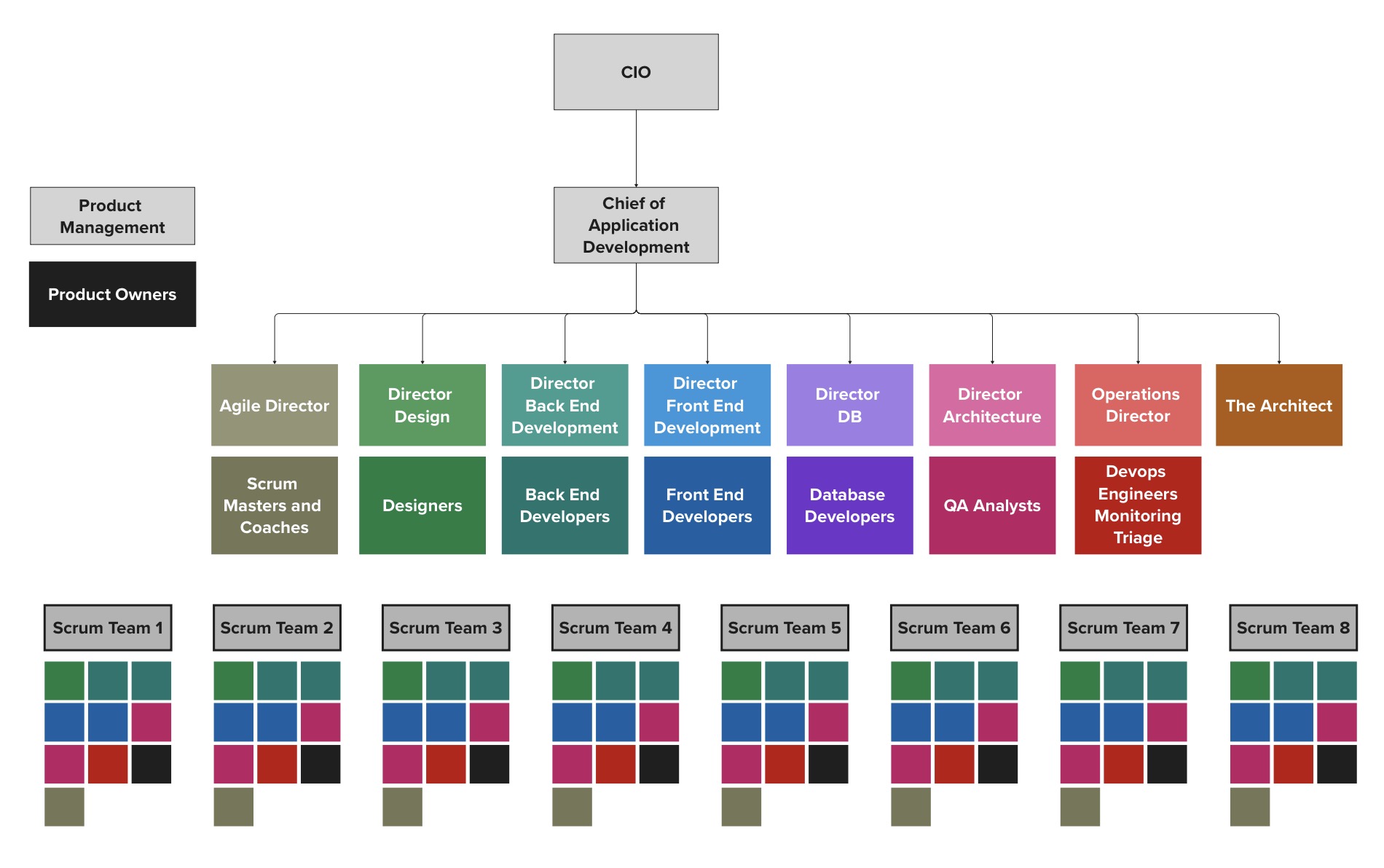
Functional silos exist to maximize utilization of specialists. Functional departments are the organizational structure used to keep specialists busy. Instead of each team having the capabilities it needs, teams share them.
Federal vs. Functional Decentralization
Early in a startup there are only a few people. Each has a specialty, but they work directly with one another to get the company running. The group functions as a small cross-functional team.
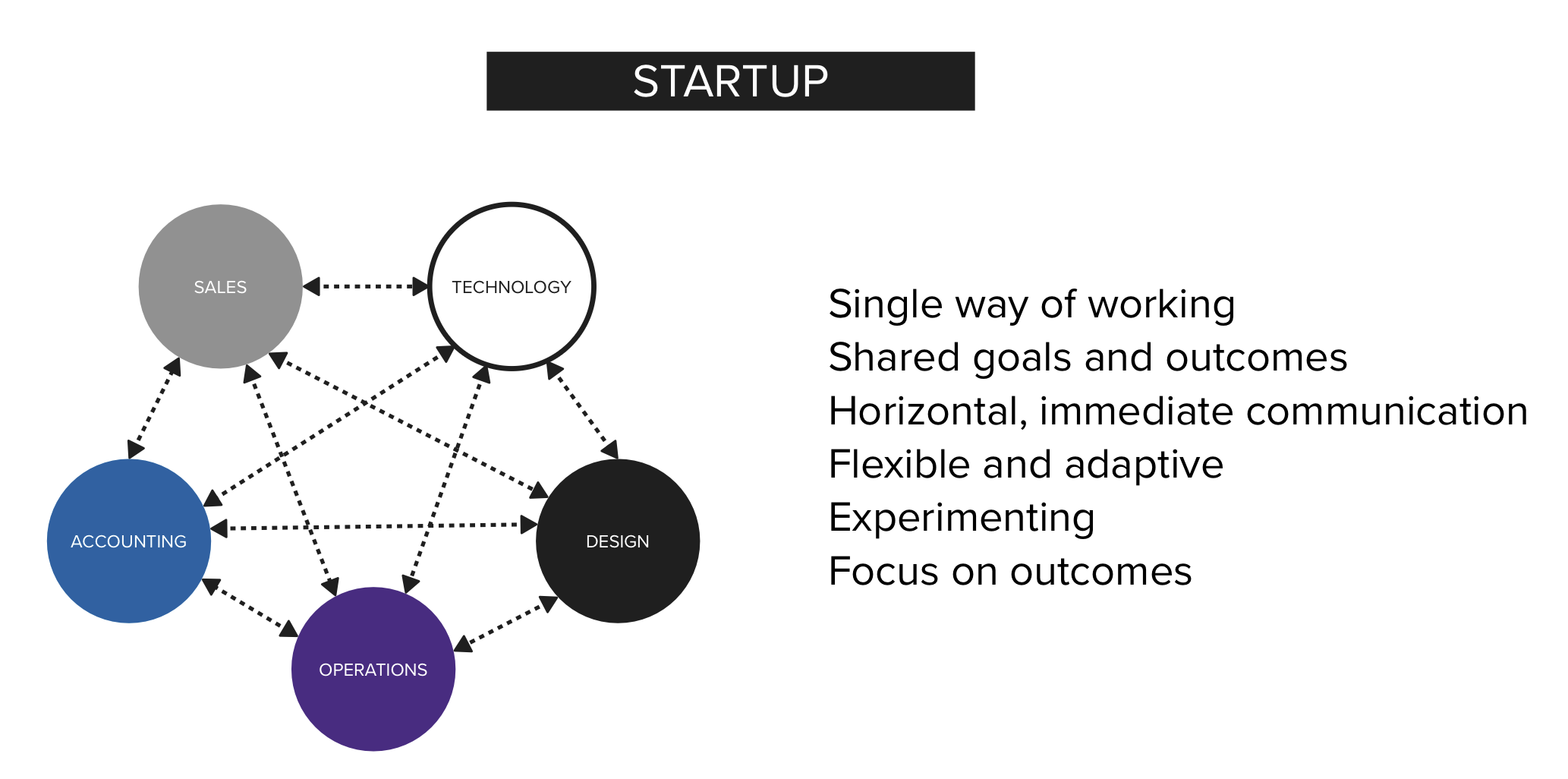
As the company grows, specialists are hired. The technical lead hires engineers, sales hires sales staff, and operations expands. The organization scales by grouping people by specialty, forming functional silos.
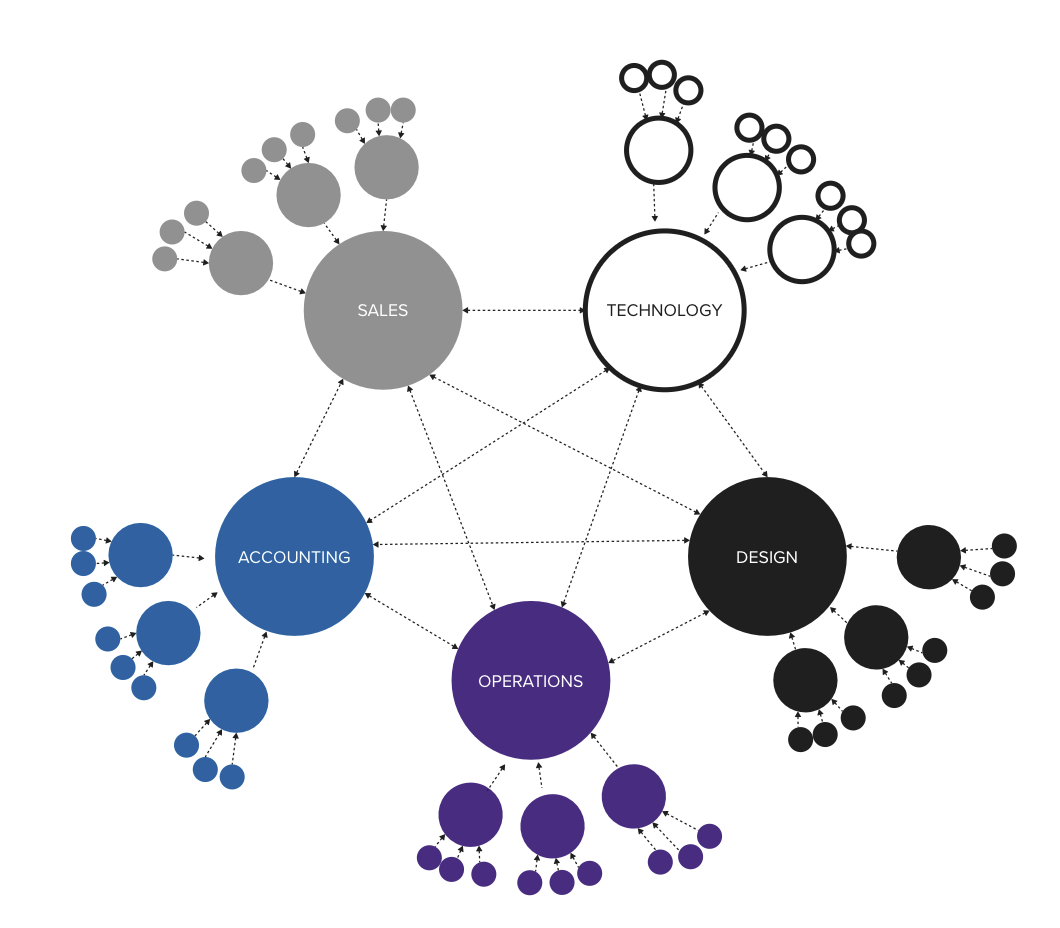
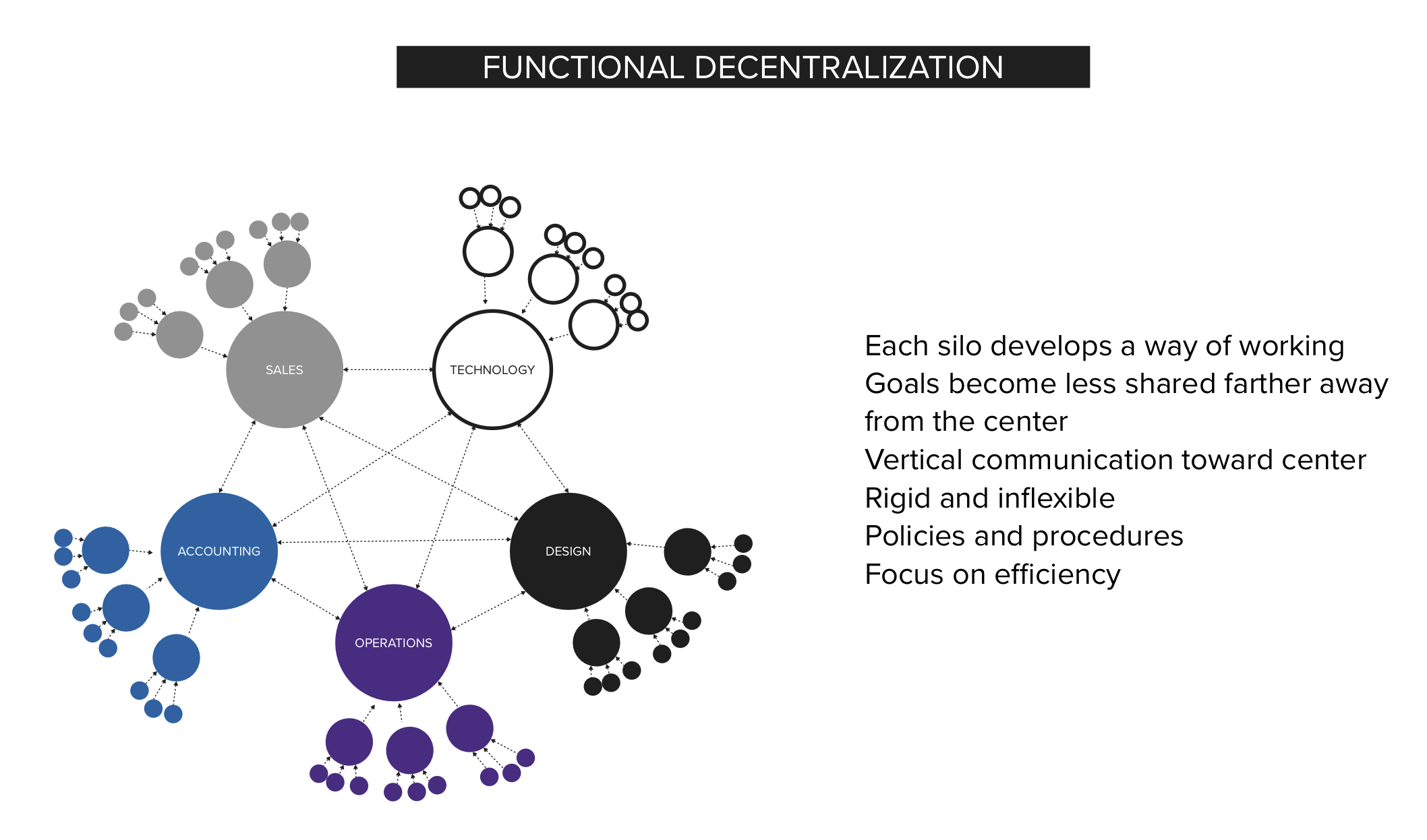
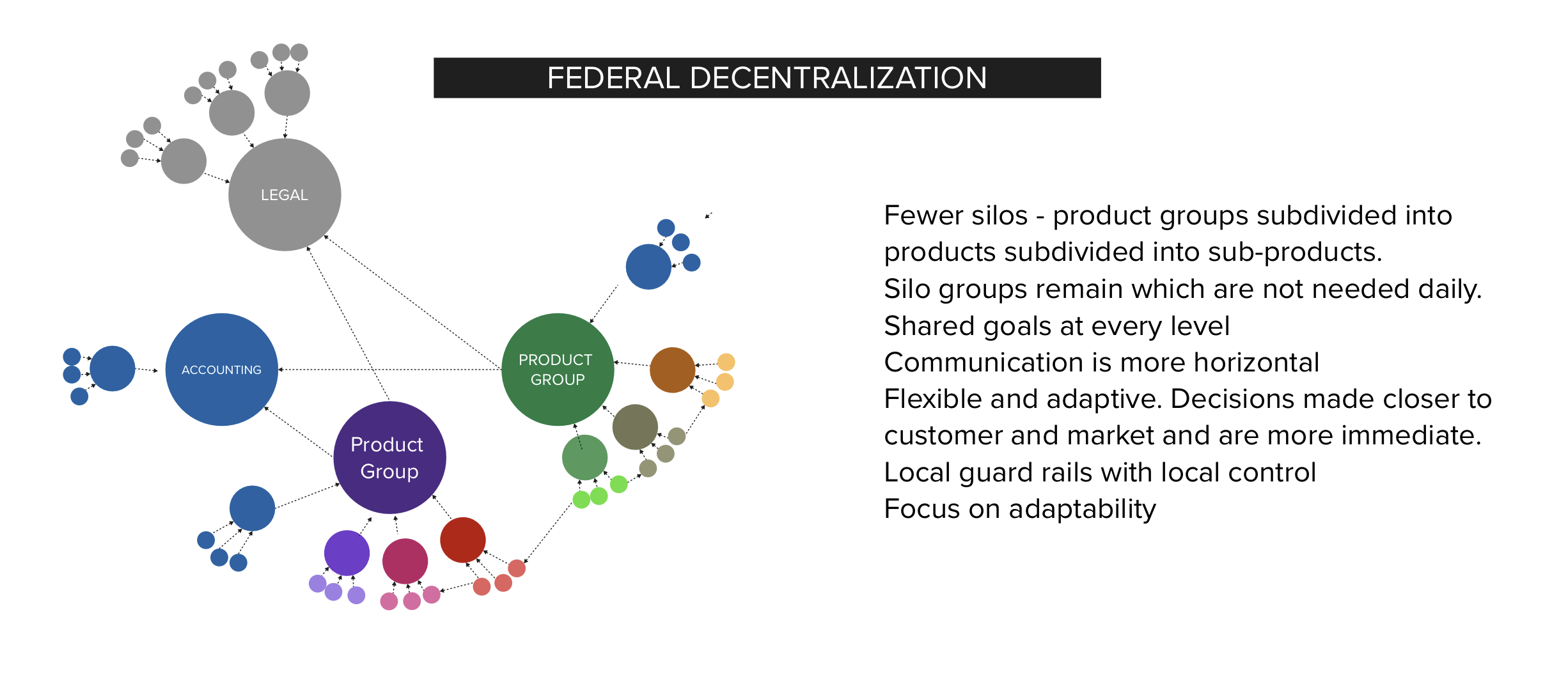
Functional Decentralization. As growth continues, direct collaboration is replaced by communication through management layers within each specialty. Decisions travel vertically inside departments rather than across the work itself. The silos continue to subdivide into more specialized groups. Policies and procedures are created to coordinate the growing structure. The goal is to scale while maintaining consistency and control. This structure improves local efficiency but increases dependency between teams.
Federal Decentralization. Instead of scaling through specialty divisions, the company organizes around products or value streams that operate as small businesses. Teams are formed around delivering customer value rather than specialization. Decisions are made within the group doing the work rather than moving up management chains.
The Cost of Functional Silos
Functional silos create costs that appear indirectly in other areas of the business. Each of the following results from many teams depending on the same shared team:
Waiting and Flow Breakdown
- Delay → Crossing silo boundaries requires requests and coordination, which adds waiting.
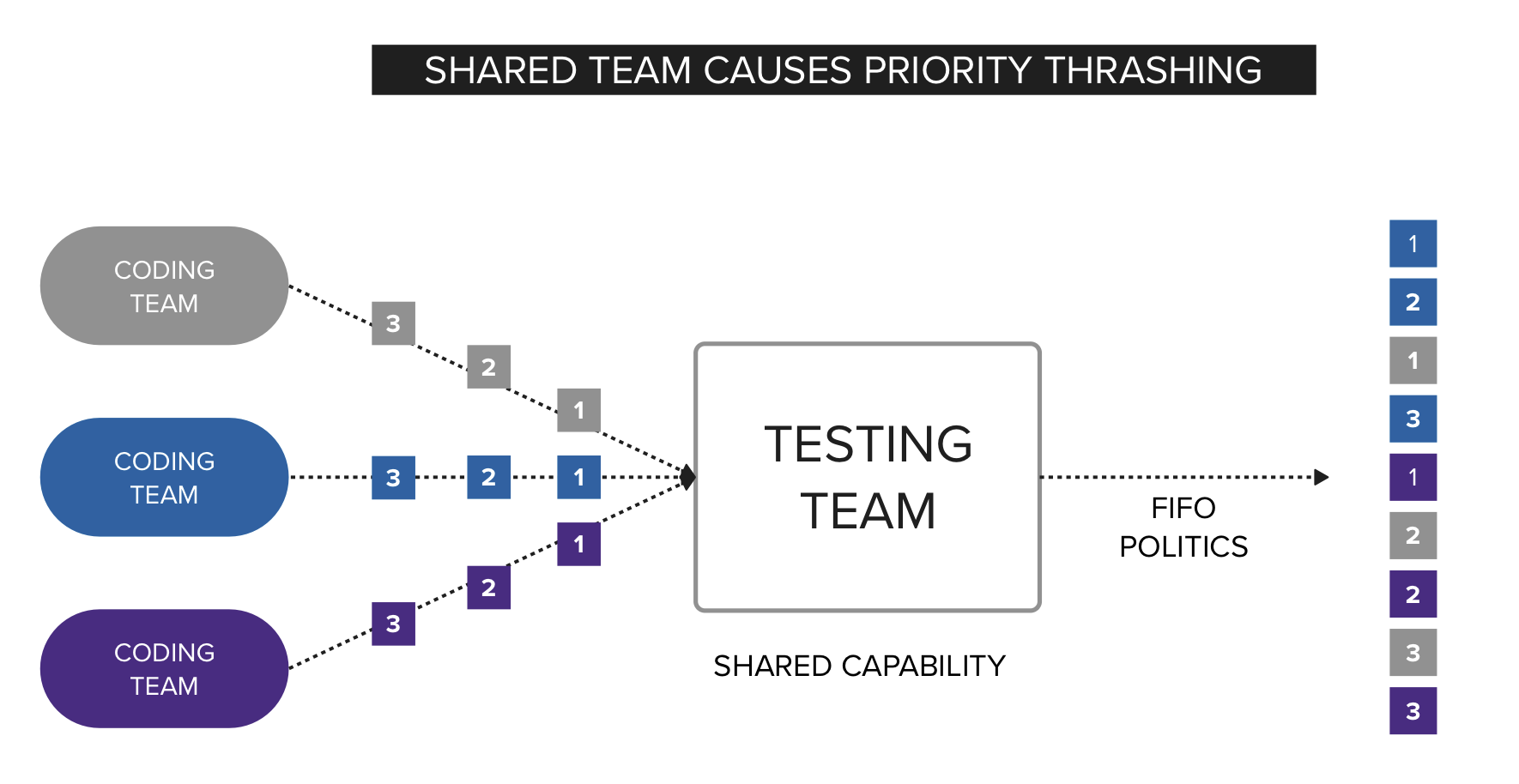
- Queueing → Many teams depend on one group, so work accumulates in front of it.
- Hidden queues → Separate tools and workflows prevent visibility across the full flow of work.
- Priority thrashing → Competing requests repeatedly reorder work, leaving items partially done.
- Longer defect resolution time → Fixes must pass through multiple groups before completion.
Work Expansion and Batching
- Batching pressure → Slow handoffs encourage grouping many requests together before sending them.
- Handoffs and re-learning → Context is lost between groups and must be rediscovered.
- Coordination overhead → Work requires ongoing meetings and tracking to keep groups aligned.
- Expediting tax → Urgent work interrupts planned work and slows overall delivery.
Economic Consequences
- Cost of delay amplification → Slower flow keeps more unfinished work open at the same time.
- Local optimization → Each group improves its own efficiency even when overall delivery slows.
- Risk concentration → Larger batches and slower delivery increase the impact of problems.
Learning and Adaptation Constraints
- Local improvement blocked → Teams cannot directly change tools or workflow affecting their work.
- Delayed feedback → Information passes through intermediaries before reaching the people doing the work.
- Defect accumulation → Problems remain open longer and accumulate.
- Decision distance → Decisions are made farther from the work and take longer.
- Process rigidity → Changing the workflow requires coordination across multiple groups.
- Reduced ownership → No single team experiences the full lifecycle of the work.
Container Ship to Speedboat
Federalized teams are created by design to place multiple capabilities inside the same group so fewer external requests are required. With fewer dependencies, queueing decreases and decisions happen closer to the work. Teams that own delivery from start to finish can respond to changes more quickly.
In a functionally organized company, the organization moves as one large unit. If a shared system fails, many teams stop at once. Processes defined centrally change slowly because they affect many groups. The company operates like a container ship: stable but slow to turn.
In a federally decentralized organization with cross-functional teams, the container ship becomes a fleet of speedboats. Each team can change direction independently. If one encounters trouble, others continue. Coupling is reduced and the organization responds to change more easily.
Innovation
Another outcome of federal decentralization is increased innovation. Many functionally siloed organizations try to gather ideas through suggestion programs, review boards, or surveys.
In a siloed structure, ideas must travel upward through the same approval paths as other work. They compete with operational priorities and wait in review queues. By the time they are evaluated, context is reduced and urgency has faded. Many ideas lose momentum before they are tested.
Innovation occurs when teams are able to try different approaches and observe the results.
If all teams must use the same tool, changes to the tool require approval rather than experimentation.
If all teams must follow one process, improvements must be coordinated instead of tried locally.
When decisions are made away from the work, teams have less ability to test ideas. Innovation depends on the ability to run small experiments.
Unleashed
A team wants to change its workflow. They open the tool settings, discuss options, and update the configuration. The change takes minutes. Their measures improve, and they share the approach with other teams. Some adopt it and adjust it further. The practice evolves through repeated small changes.