
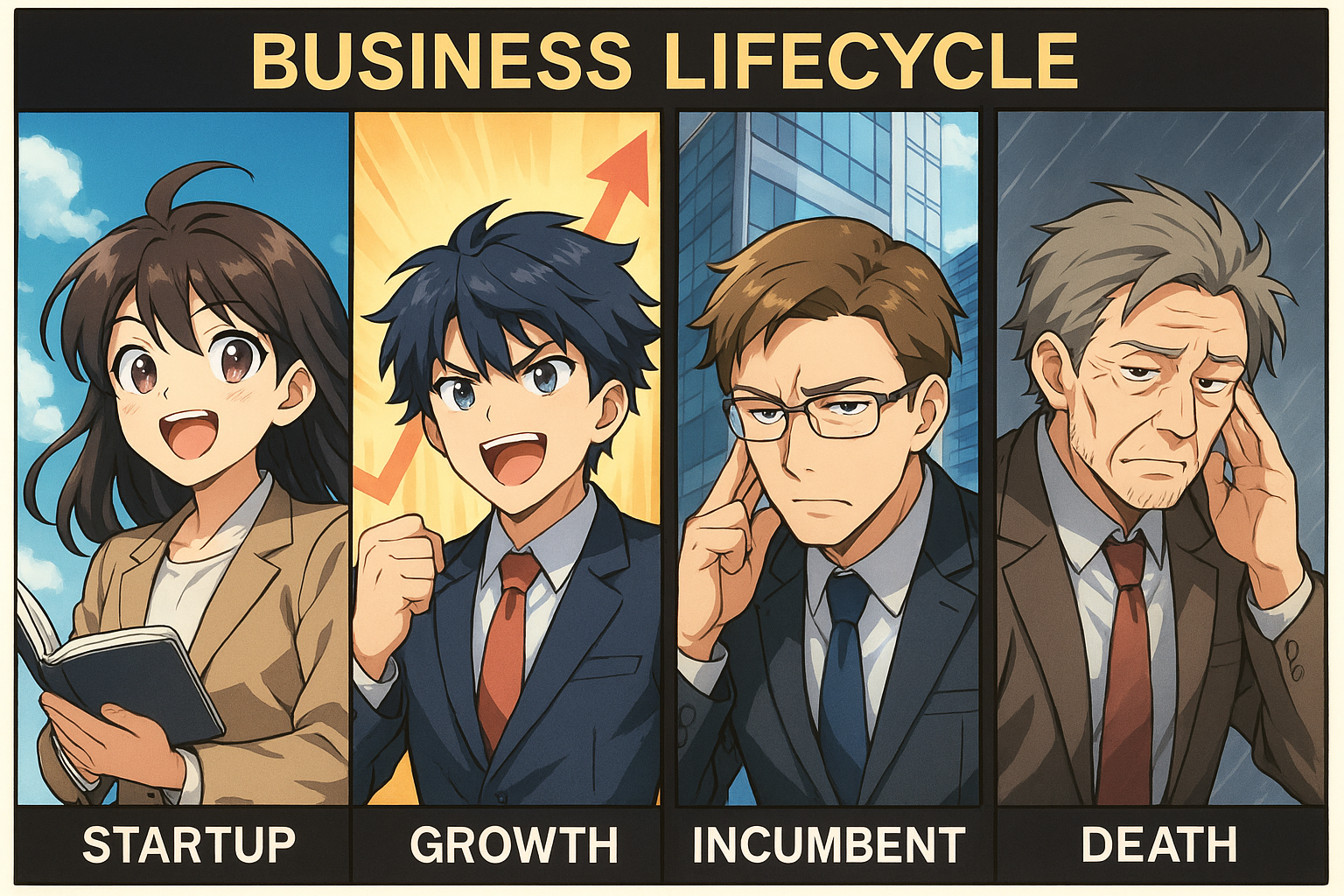
Businesses and products, much like people, lead temporary lives. From the moment they are launched, they face pressure from investors to grow and deliver returns, pushing them through a predictable arc of evolution. This repeating pattern is commonly referred to as the business lifecycle. While many frameworks describe various stages, I believe the lifecycle can be distilled into four essential phases: startup, growth, incumbent, and death.
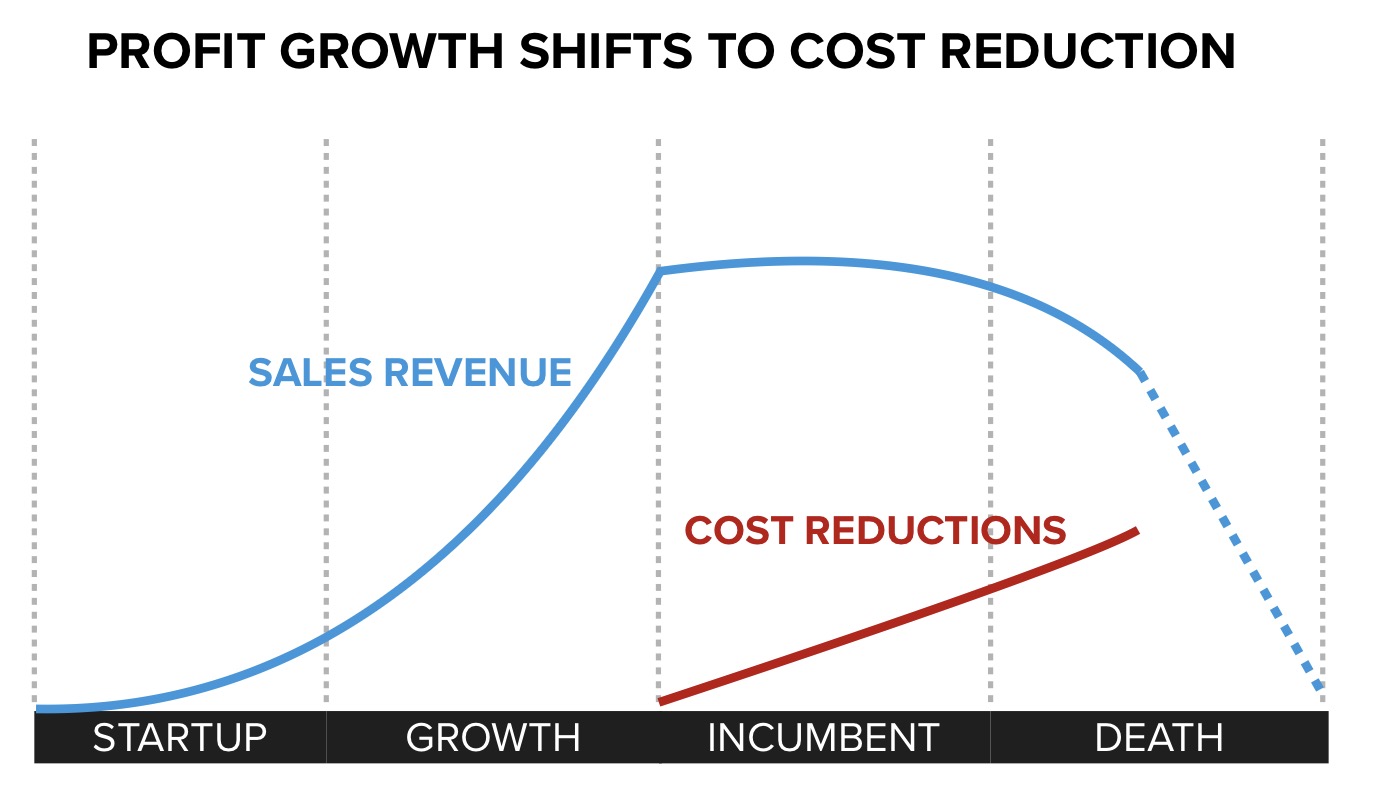
In the startup phase, an idea backed by capital struggles to become self-sustaining through sales. Most businesses never make it past this stage. Those that do enter the growth phase, rapidly scaling operations and formalizing structure. Eventually, growth slows, and the business becomes an incumbent, focused on cutting costs and optimizing efficiency to sustain profits. When cost-cutting can no longer offset declining sales or retain talent and quality, the business enters its final stage: death.
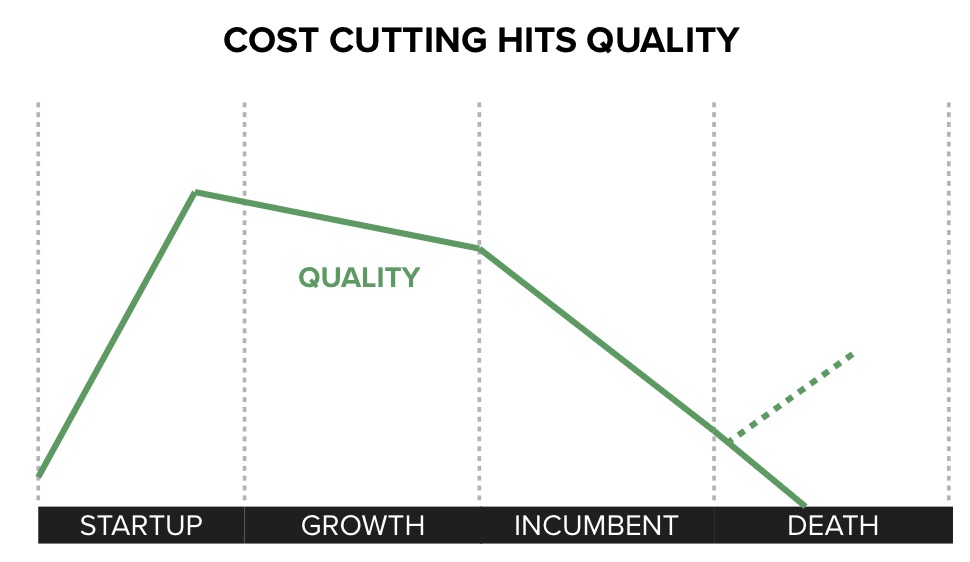
Quality suffers as a result of cost reductions at scale. When a business is organized into traditional silos rather than independent product units, it becomes brittle due to all of the centralized, standardized systems, processes, and decision-making. In such a company, cost cutting hits all of these silos similarly, damaging the entirety of the company. Managers with high awareness or replacement management may come in with a rescue plan to improve quality realizing that cost cutting does not bring customers back (dotted line). But, these attempts will not work if cost cutting is maintained as a priority. Organizations that are optimizing for efficiency do not do quality work.
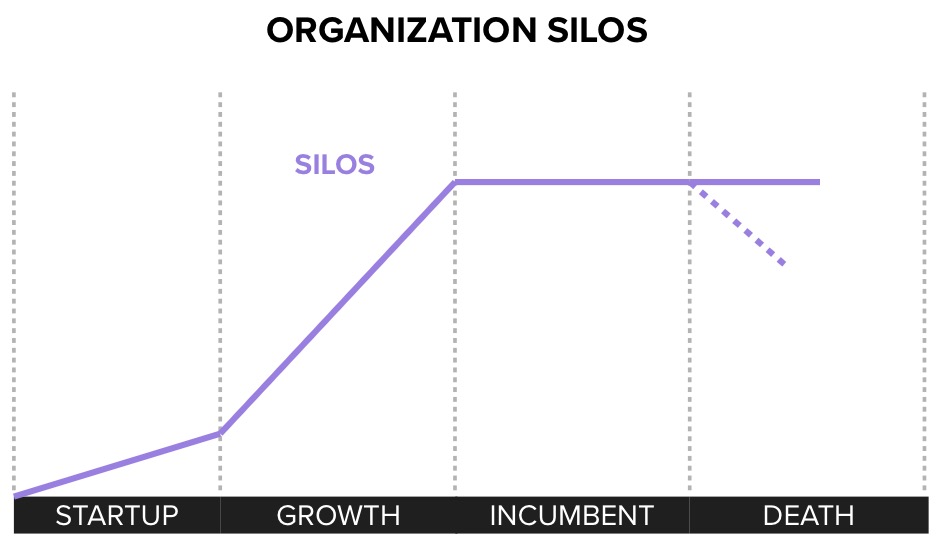
As the organization grows, silos form. Operations, HR, Legal, IT, Sales, Finance, Marketing… all form functional silos at different scales. This helps the founders maintain a sense of control, but it creates massive overhead costs from coordinating between departments. Leaders begin political favor-trading on access to their silo’s capacity. Further overhead costs emerge from finger-pointing, blame-storming, and turf wars as control over projects is rarely clear. Product development slows to a crawl as delays and vertical communication and approval chains create bottlenecks that obstruct people on the line from being as agile as the founders were during startup.
A rescue operation from replacement management may attempt to save things by removing old management structures and reorganizing around value to speed up processes and remove vertical cruft and bottlenecks (dotted line).
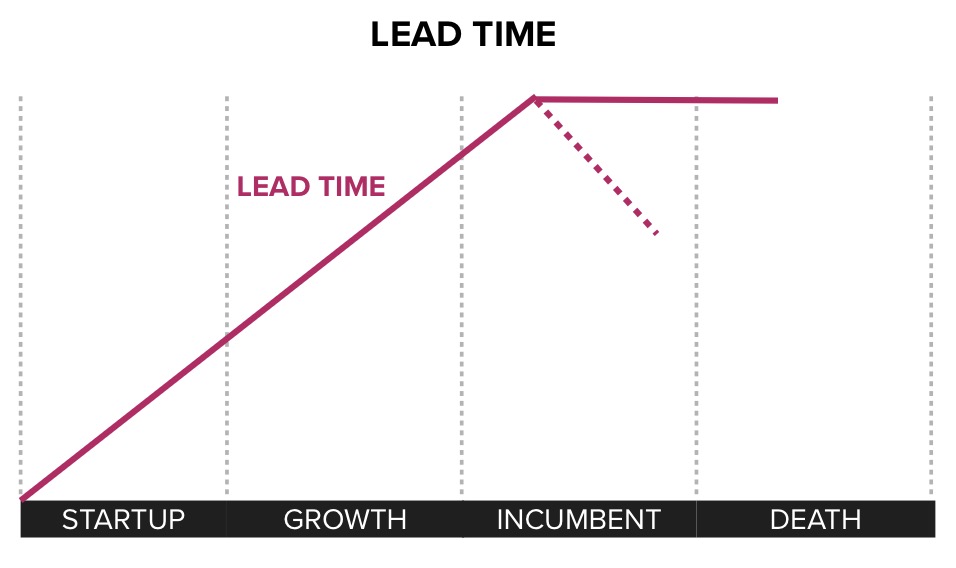
A successful startup can develop a product feature from idea to reality in days. This is how they disrupt and ultimately destroy the large incumbents. But as growth sets in, the organizational silos and reduction in quality cause process embellishments that continue to drive up time-to-market (the amount of time from idea to customer delivery). Often, organizations lose track of the number of days it takes them to develop a new feature for a product and do not even measure it. They continue to add more and more approvals, checks, reviews, and audits, all attempting to prevent mistakes or control costs, meanwhile, the increasing time-to-market is like a cancer that is growing the entire time. Replacement management brought in by investors before death may understand this and make sweeping changes to reduce time-to-market and give the organization the agility it needs to fight its final battle and at least have a chance of surviving (dotted line).
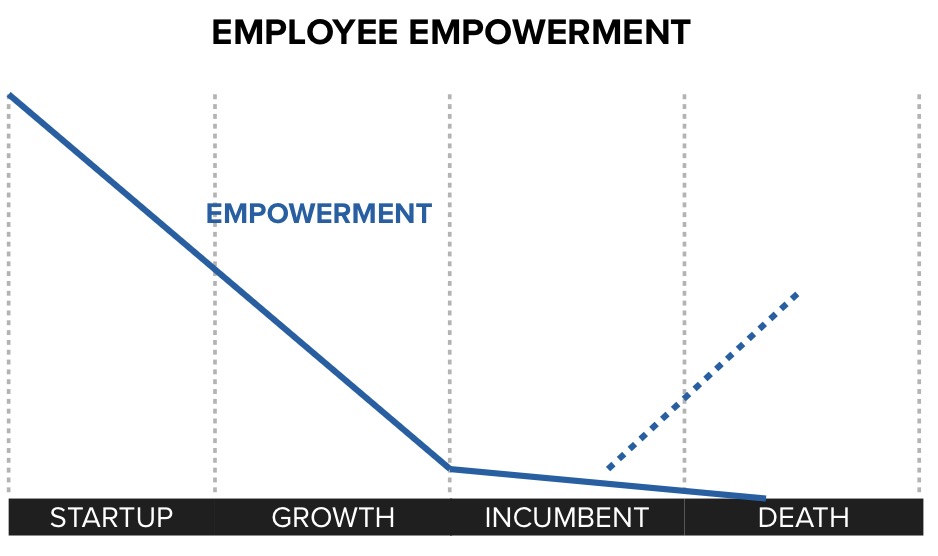
Startups provide incredible levels of autonomy. During my time in one, I was welcomed with, “There’s work lying around everywhere. Pick something up and get it done. Then pick up something else. Go! GO! NOW!” Large incumbents optimized for efficiency which are almost entirely focused on holding position by averting risk and controlling costs rarely offer autonomy.
Instead, employees have small jobs with low levels of responsibility. Take the requirements from the customer, and hand them to the engineer. Employees are told what tools to use, refer to policies as to how to use them, and must request permission or approval for any decision-making.
Replacement management may come in and see that there is a gold-mine of minds available if they can steer the culture in a new direction (dotted line). They may also institute measuring business value.
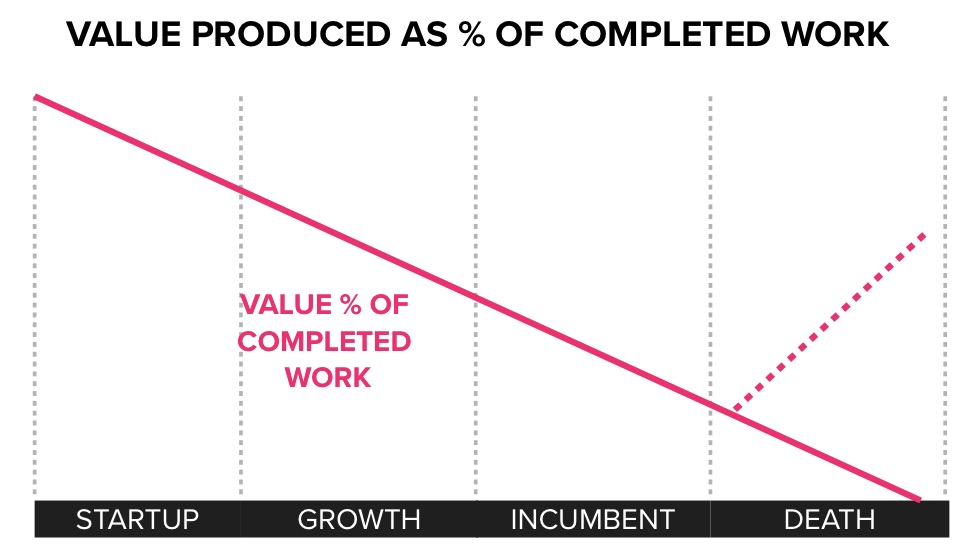
Early in the lifecycle of a business, the founders can be heard saying to one another, “We need to put something in the market!” or, “I don’t care about the rules. Just get it done!”
The things they plan to do and work on are the most valuable things and bureaucratic concerns are deferred and often ignored. When a big company veteran joins a startup, they are often horrified by the lack of governance and concern for details and documentation.
When a company becomes a large incumbent, management is heard saying things like, “We need to hold people accountable,” and seems more focused on not being cheated by lazy employees enjoying their time on the job than with actual productivity. Employee utilization is maximized to ensure that everyone earns every hour of pay they receive and that the fewest number of employees are kept on staff to perform necessary work. This utilization scheme is highly efficient until we start measuring throughput and see that as the organization learns to do with fewer people, it becomes exponentially less productive.
Large organizations are often blind to this effect because they don’t know what productivity is or how to measure it. They concern themselves with how busy the employees are and doing many things at one time. Typical performance measures are mere counting of things: numbers of reports produced, projects in-flight, software releases, town halls held, or projects completed. None of these things indicate valuable work which benefits customers or the company. These numbers only indicate that as few people as possible are highly busy producing things that may not be of any value.
How to Live a Longer Life
The business lifecycle is not a warning for those in startup mode. Startup leaders are rarely concerned with the inane goings on that will come later during incumbency. They plan to cash out and move on. Startup people are not administrators. They typically leave and go to a new startup or step back into figurehead mode while the administrators they hire run things after the company grows large.
The lifecycle is instead a wake-up call for the administrators who have joined the large incumbent business that has become complacent and relies on layoffs and cost control to increase profits. This behavior appears effective. Perhaps for years or decades, but the brittle structure of a siloed organization is easy to disrupt. Much like an old man with a cane trying to fist fight a young athlete, adherence to tradition and avoiding risk will not prevent being thrown to the ground by a younger, more agile opponent.
The solution:
- Large businesses must organize themselves in ways that render them colony organisms of small startup-like groups.
- The decisions that were retained by the founders for themselves that now live at the top about budgets, spending, and which direction to go need to be delegated to these empowered teams.
- Quality cannot be had on the cheap. Perhaps there is some company focused on cost-cutting organization that is improving quality. I haven’t heard of it. I doubt it exists. You can optimize for quality, performance, or efficiency. Pick one.
- Measure your time-to-market. If you don’t know how agile your organization is, find out. Know this number to the day.
- Increasing time-to-market means you are mismanaging your process. Too many controls, too many checks, too many vertical conversations, too little empowerment.
When is it too late for a big company? No one can say for sure. My observation is that when it is too late, the employees know it and are already complaining that the products they build don’t compete. Management, however, is often blissfully unaware and believes cutting a few more expenses will do the trick while employees are astonished at how disconnected management is from what is happening with customers.
Where are my case studies? Think of a company you used to love 20 years ago. Think about how you used to talk about how great they were and how they were becoming something you relied on. High quality, great service, good people, fair prices… your favorite company burst on the scene and took out a few incumbent players which you started to ignore. The incumbents ran discounts and sent you coupons, but it was too late, they were dead to you. Now, 20 years later, your favorite company has become something else. They have raised prices, served too many ads, reduced their food portions, or they started offering cheap products or falsifying reviews. Now you think they are garbage. Your favorite company has traveled from startup, to growth, and is now an incumbent cutting costs with a massive pyramidal empire within. I don’t need to name examples. You already know who they are.