
“I need your help.” It was a vice president of technology for a corporation. “We have to learn to do more with less. What do you have in that bag of agile tricks that will help us do that?” There is an assumption that Scrum or some other framework will increase speed and therefore productivity.
What he was asking for was a decrease in cycle time and an increase in throughput. In most cases, this occurs only when waste is removed through automation or through the reduction of rework.
Automation and rework reduction increase effective capacity without expanding staffing. Rework occurs when completed work must be corrected or rebuilt. This consumes capacity that could otherwise produce new functionality. Reducing rework increases the amount of new output produced with the same resources.
This article examines methods for reducing rework in software development. It emphasizes early defect prevention and the use of automation to detect errors before release. It distinguishes between preventable mistakes and adaptive changes based on new information. Only the former represents waste.
The Cost of Defects and Rework
Rework occurs when defects are discovered after work has progressed. The longer a defect remains undetected, the more completed work depends on incorrect assumptions. As detection latency increases, more work must be revisited, increasing correction cost.
When defects are detected during:
- Full release to all customers – Defects discovered after full release have remained undetected the longest and may affect the entire customer base. Correcting defects in a live environment requires additional coordination and increases total resolution cost.
- Limited release to a segment of customers – Defects discovered during limited release affect fewer users than those that affect the entire customer base. Restricting initial release reduces the number of affected users and limits total correction cost.
- Pre-release validation – Defects discovered after integration but before release require revision across combined components. More completed work is affected than during implementation.
- Implementation – When defects are discovered during implementation, work must pause while design assumptions and build choices are corrected.
- Ideation – When ideas are based on incorrect assumptions about technical feasibility or lack sufficient clarity, those assumptions must eventually be corrected. The earlier they are surfaced, the lower the rework required.
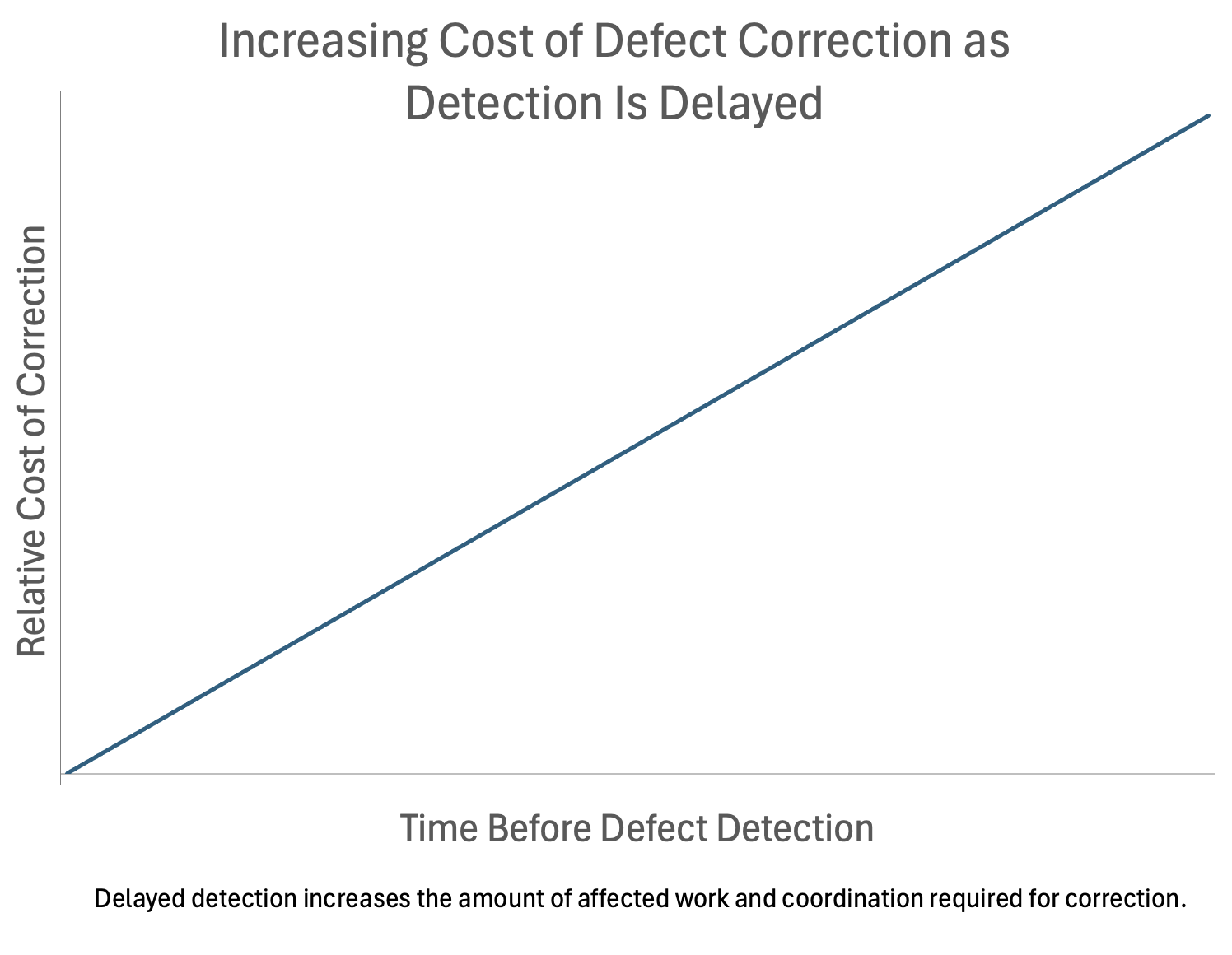
Estimates of the economic cost of software defects vary widely. While precise measurement is difficult, defect-related rework represents a material cost within development systems.
Reduce Rework
Effective capacity increases when rework is reduced. Rework represents work that re-enters the system after progressing forward. Each re-entry increases cycle time and consumes additional capacity. Preventing defects reduces rework and shortens cycle time.
Defects are inevitable in complex systems, but their impact depends on detection latency. Testing limits downstream exposure, but it does not eliminate the introduction of defects. Practices that provide immediate feedback during implementation reduce the time between introduction and discovery. Automation accelerates this feedback, reducing rework scope.
Iterative delivery shortens the time between idea formation and validation. By reviewing working software early, stakeholders surface incorrect assumptions before they propagate. Reducing hand-offs and bringing decision-makers closer to implementation decreases interpretation drift and lowers rework scope.
A distinction must be made between rework caused by defects and rework caused by learning. Defect-driven rework results from delayed detection of incorrect assumptions. Learning-driven change occurs when new information emerges through use or experimentation. Only the former represents avoidable capacity loss.
Automation
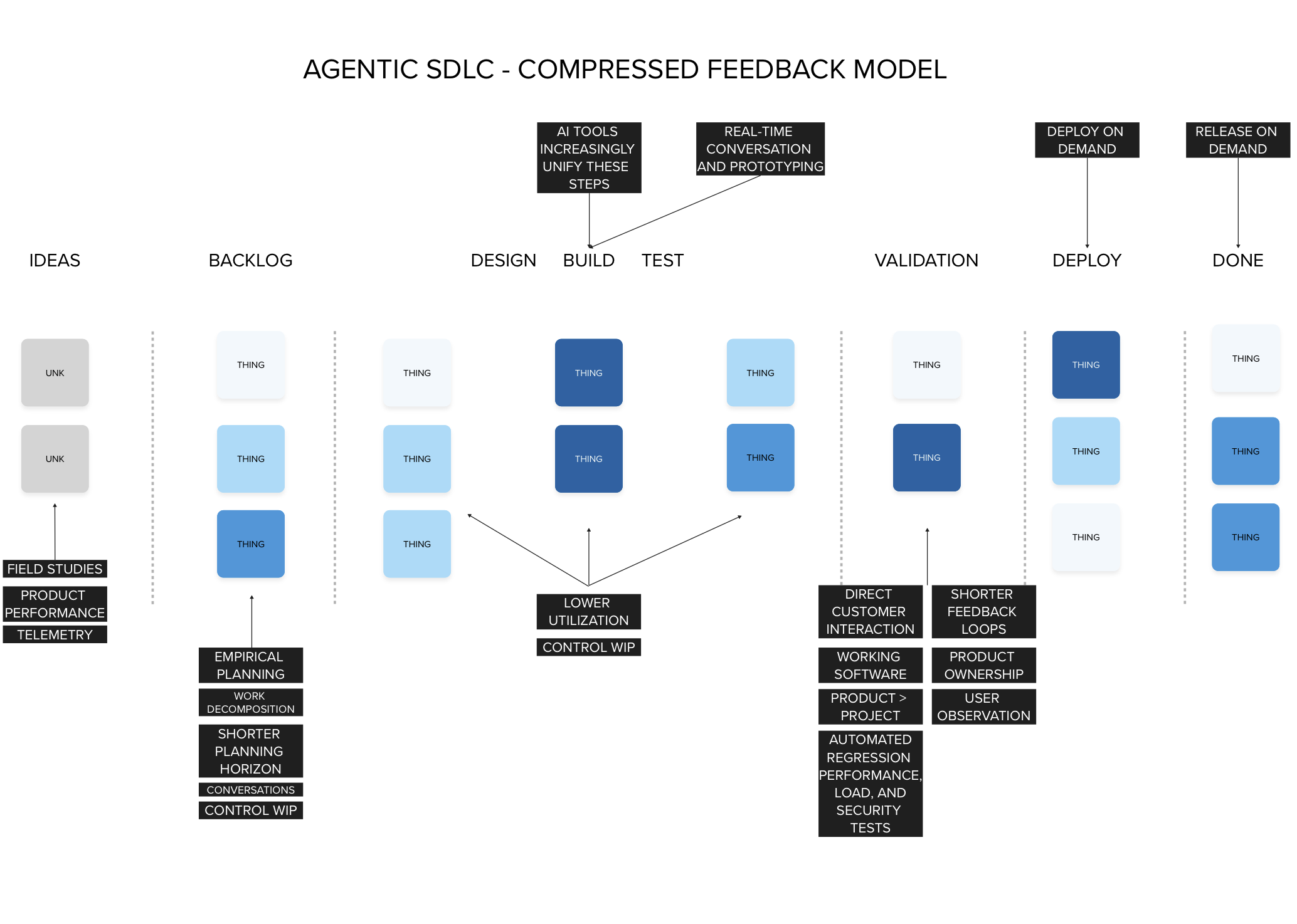
Automation increasingly compresses activities that were historically separated across the software development lifecycle. Coding, testing, validation, and deployment can now occur within tightly coupled feedback loops rather than sequential stages. As these loops compress, detection latency decreases and rework scope contracts, increasing effective capacity. The diagram below illustrates how agentic tooling collapses traditional boundaries while reinforcing flow controls such as WIP limits and shorter feedback cycles.
Automation Cannot Do Everything… Yet.
Manual testing remains important because not all defects are predictable. Exploratory interaction with a system can surface unexpected behaviors that automated checks are not designed to detect.
AI systems can now generate significant portions of application code. However, it is not yet clear whether this reduces overall defect density or shifts defects to different categories. Empirical evidence is still emerging.
While automation can validate code behavior, it does not replace the need for direct stakeholder engagement. Misalignment in intent is best surfaced through conversation and shared context rather than through document hand-offs. Increasing separation between decision-makers and implementers increases detection latency for requirement defects.
Ineffective Schemes to Increase Capacity
Decades of research in operations management and queueing theory have identified practices that unintentionally reduce effective capacity. The following patterns are commonly adopted with the intention of increasing output, yet often produce the opposite effect.
- Getting started early. Beginning work too far in advance increases the planning horizon and the likelihood that assumptions will change before delivery. When assumptions change, defects in requirements or understanding are discovered later, after additional work has been completed. The longer those misunderstandings remain undetected, the more rework is required. Starting work at the last responsible moment reduces the risk of delayed discovery and unnecessary revision.
- Working on more things at once. Starting additional work items increases the number of unfinished tasks in the system. As unfinished work grows, each item tends to take longer to complete. When completion takes longer, problems are discovered later and more work must be revised. Limiting the amount of work in progress helps issues surface sooner and reduces rework.
- Resource utilization. Keeping everyone fully occupied appears efficient, but when work arrives unevenly, high utilization creates waiting. As waiting increases, tasks take longer to complete and problems are discovered later. Later discovery means more completed work must be revised. Allowing some unused capacity reduces delays and helps issues surface earlier.
Lessons from the Factory Floor
Reducing rework, limiting work in progress, shortening planning horizons, and accelerating feedback all reduce time in system. When time in system decreases, defects are discovered earlier and rework scope declines. These ideas are not unique to software development. They reflect principles of flow and constraint management developed in manufacturing and operations research over many decades.