
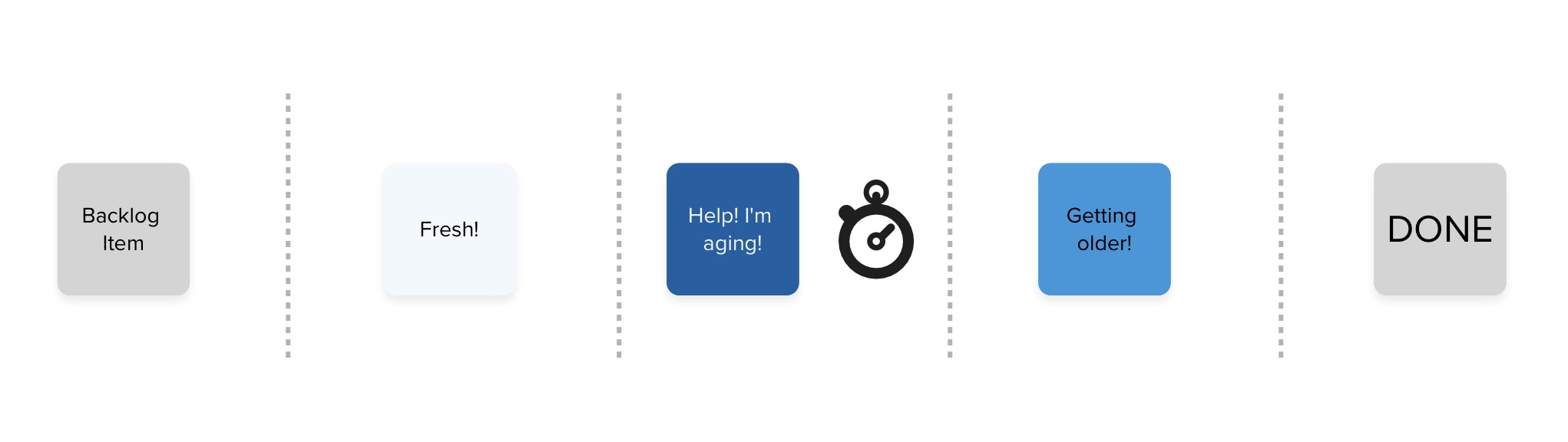
Performance measurements help us to monitor system performance and make improvements. An automobile engine has many measurements, many hidden from the driver. Some of these measures are engine temperature, rotations per minute (RPM), oil levels, transmission fluid levels, oxygen levels, timing, and pressure. Without sensors detecting these measures, the onboard computer, and in some cases the driver, would not be aware of problems or be able to tune the engine to run properly. Operating any system without measurements leaves us making decisions based on our feelings rather than facts.
Kanban is a strategy for visualizing and managing the flow of value through a process. It comes to us from automobile assembly lines where the flow of cars through a factory was carefully measured allowing for often unintuitive changes to the line to improve the flow of quality and products. Today, it is being adapted for use by organizations and agile teams to help understand software development lifecycles and make improvements. Kanban can be used by almost anyone to manage queued and unfinished work to create transparency around performance.
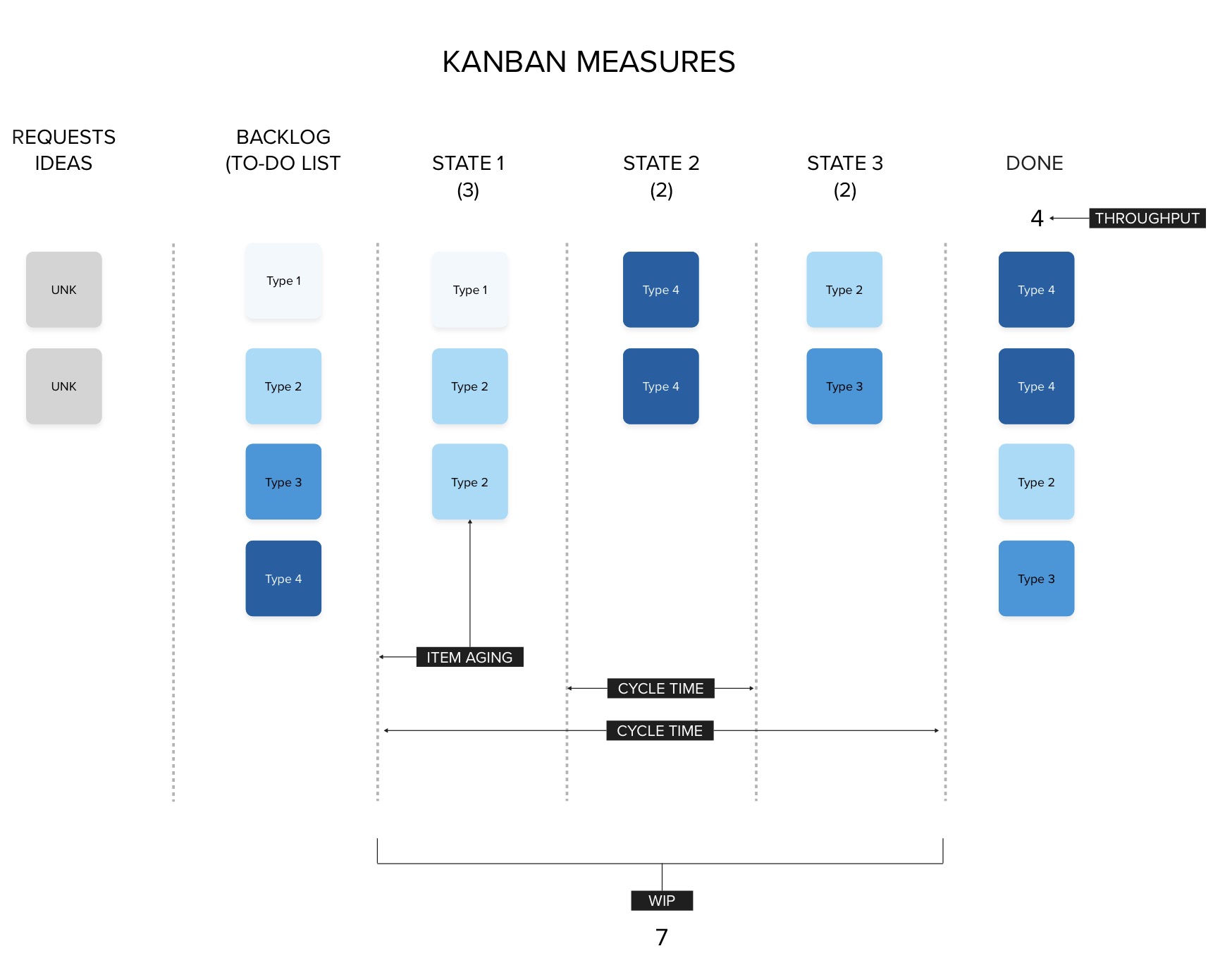
Kanban emphasizes four key measures of flow: Work in Progress (WIP), Cycle Time, Throughput, and Item Aging. These metrics provide critical insights into how work flows through your system, enabling you to identify bottlenecks, improve predictability, and optimize performance.
- WIP represents the amount of unfinished work currently in progress. Keeping this number low allows work to flow more smoothly through the system.
- Cycle Time is the total time it takes to complete an item, typically measured from when it starts to when it finishes, though it can be measured between other points.
- Throughput is the total number of items completed over a specific period.
- Item Aging tracks the amount of time an item has been in progress without being completed.
In this article, we’ll focus on Item Aging, a critical measure of flow. While all four metrics are important, Item Aging stands out as the most actionable for improving flow in real time.
Stop Going Around the Table
“Going around the table” is the default structure for many status discussions. Rather than focusing on the work itself, these meetings shift attention to people. Each person takes a turn describing how busy they are and emphasizing the importance of their tasks. Such meetingsare especially prevalent in environments organized by functional silos.
Take, for instance, a PMO staff meeting with eight project managers and their supervisor. Each project manager is asked to share updates on their projects. Since none of the other project managers are working on the same projects, the updates hold no value for them. They often multitask on laptops or phones, or they focus on preparing their own update. For most of the attendees, the only interesting part of the meeting is the brief moment when it’s their turn to speak.
The supervisor, however, may view this meeting as productive because it centers on their need for information. They interrogate each project manager in turn, take notes, and assemble a narrative about overall progress. These meetings often require additional deliverables, such as PowerPoint presentations with status reports divided into red/yellow/green quadrants.
However, this type of meeting is not a working session. The project managers do not collaborate to solve problems, share outcomes, or support one another. The organizational incentives are often misaligned: one project manager’s success may indirectly disadvantage another, discouraging cooperation. In this setup, there is little motivation for anyone to engage meaningfully with their colleagues’ challenges.
These meetings amount to management theater. They give the appearance of productivity but offer little tangible value beyond updating the boss. The supervisor may feel they are contributing by critiquing approaches, issuing orders, or directly intervening to address problems. However, these actions are often superficial fixes that fail to address underlying root causes.
Status update meetings structured around “going around the table” are themselves a symptom of deeper organizational dysfunction. In healthy, effectively run organizations, such meetings are rare or nonexistent.
Stop Using The Three Questions in Scrum
Previous versions of the Scrum Guide contained three questions as a suggestion for a possible way to run the Daily Scrum:
- What did I do yesterday?
- What am I doing today?
- Do I have any impediments?
This was dropped in 2020 from the Scrum Guide because of so many observations of how Daily Scrums were becoming boring status updates that provided developers no support at all. Going around the table in the Daily Scrum basically turns this otherwise useful inspect and adapt event in Scrum into an update meeting designed to facilitate micromanagement.
As Scrum teams began doing Scrum With Kanban, this problem became more visible as inspecting and adapting the Sprint Backlog (historical tracking) became the priority over holding useful discussions and making plans (future thinking).
Focus on Unfinished Work
Item Aging measures the time that has elapsed from when an unfinished work item was started until the present moment. By tracking item aging for work-in-progress (WIP), teams can identify items that are not advancing through the system as expected and prioritize addressing the oldest unfinished items first. This shift transforms discussions from unproductive status updates into actionable problem-solving sessions.
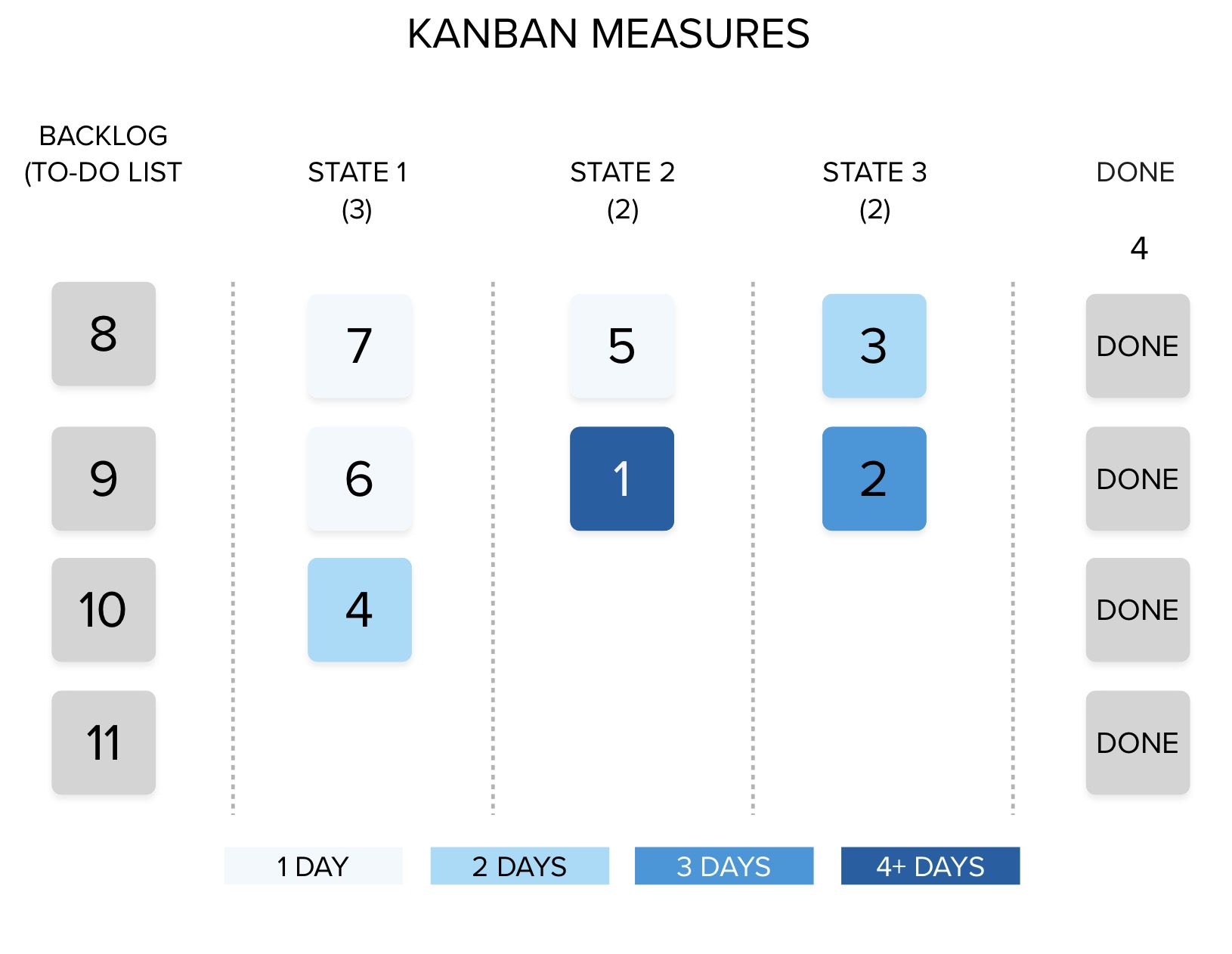
Using Item Aging brings the focus back to the work itself, rather than the people doing the work. It doesn’t matter what Rob is working on. What matters is that Item 1 appears stuck in State 2. The team’s attention shifts to diagnosing and resolving the issue:
- Is there a dependency blocking Item 1?
- Is the item too large or complex to move forward?
- Are there gaps in expertise needed to complete it?
- Could something in State 3 be preventing progress?
- Did the team mismanage WIP limits, pulling Item 3 instead of focusing on Item 1?
These discussions drive meaningful improvements, helping teams manage their workflow and address problems for both the present and future.
Practical Guidelines for Item Aging Discussions
When reviewing work using Item Aging, focus on these priorities in this order:
- Examine items in progress from oldest to youngest.
- Review the board from right to left.
The example above illustrates aging thresholds, but every team should determine its own benchmarks for when an item has aged too long. At a certain point, an aging item should become the team’s top priority to resolve. By ranking items for discussion based on their age, teams ensure that conversations start with the most critical issues.
This approach organizes discussions like a prioritized backlog, aligning them with lean principles. Meetings change to addressing the work that matters most instead of assigning blame or giving status updates. Item Aging is the time from the moment an unfinished work item is started until the present moment. By measuring item aging on our current work-in-process, it is possible to focus in on items that are not moving through the system the way that they should, and address the oldest unfinished items first. Discussions around current work can improve from a mere “going around the table” to something more productive.
ProKanban.org. (n.d.). The Kanban guide. ProKanban.org. Retrieved December 31, 2024, from https://prokanban.org
Vacanti, D. (2014). Actionable agile metrics for predictability: An introduction. Createspace Independent Publishing Platform.
Vacanti, D. (2016). When will it be done?: A guide to predicting the delivery date of work in process. Createspace Independent Publishing Platform.