
As a manager, I was trained to maximize resource utilization. Leadership expected justification for headcount. There were over fifty people working for me, so my team was expensive. Hiring more people to expand the capacity of the team was out of the question. To manage this, I tracked how many projects each person had and who could take on more. My job was to assign work and keep everyone busy.
I developed tools to see how much work each person had. I scanned constantly for idle capacity. If someone had availability, I gave them more.
“You only have two projects? You can handle three. Here’s a third.”
This model requires functional silos. Silos make it easier to assign work and manage utilization. Headcount is controlled by keeping everyone fully loaded. It looks efficient.
Later, I learned this model was flawed. Maximizing utilization is one of the primary reasons work takes so long to complete. The problem was not idle capacity. The problem was too much work-in-process (WIP).
Little’s Law and WIP
Little’s Law has three variables: WIP, throughput, and cycle time. It can be written as
WIP= Throughput x Cycle TimeIt describes the relationship between these three variables in a system.
- WIP = the number of items in the system
- Cycle time = service time (effort) + waiting time. The total elapsed time for any item from started to finished
- Throughput = the number of items that exit the system per unit of time
Increasing throughput is possible by leaning out a process, addressing bottlenecks, and removing wasteful activities. In many systems, throughput improvements are constrained, whereas WIP is directly controllable. It can be tested time and again: by reducing the number of items in a stable system, the system flows faster.
The more work items that are alive in the system on average, the longer the average cycle time of all items in the system. Limiting the number of items in the system will reduce the cycle time of all items.
With no WIP, nothing happens. With some WIP, production increases. But beyond a certain point, adding more work causes everything to slow down. At full utilization, the system crawls.
Time for a Roller Coaster Ride
When deadlines are tight, and many things are requested of us, our natural instinct is to start as many things as soon as possible. We feel like we can get a head start on a large pile of work to ensure we complete it all. Unfortunately, the more things we start, the more that are alive in the system at once, the more we slow down.
This can be difficult to accept.
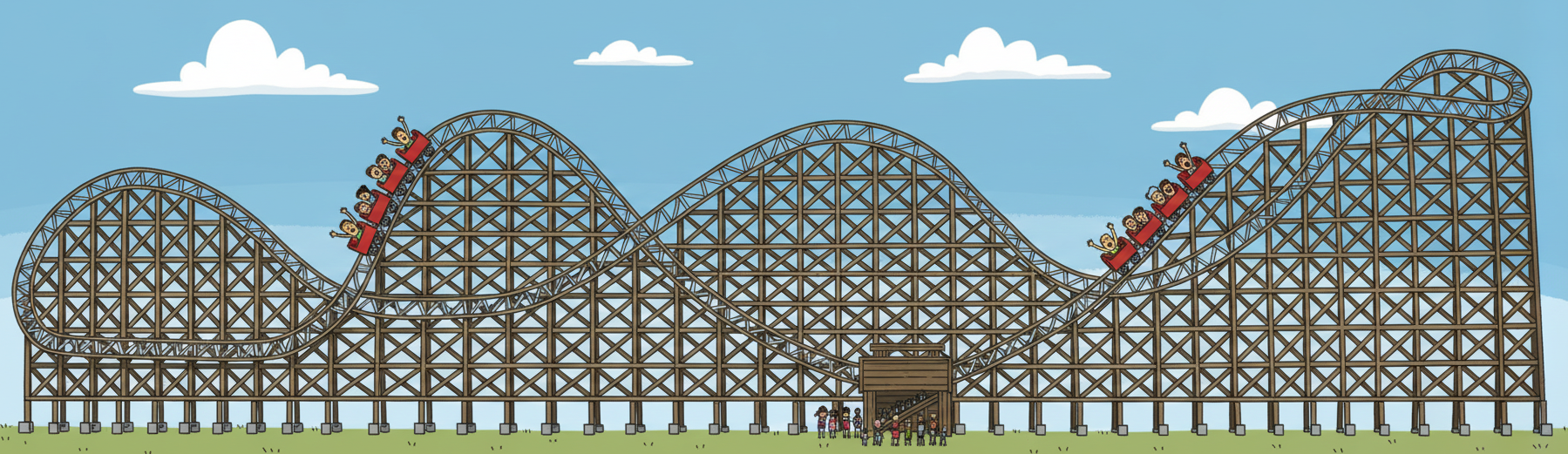
Imagine a roller coaster. I drew one here so you do not have to imagine it. Two trains of five cars are zooming along. The riders are screaming with a mix of terror and joy. It is fast. It feels like 100 mph. It is thrilling.
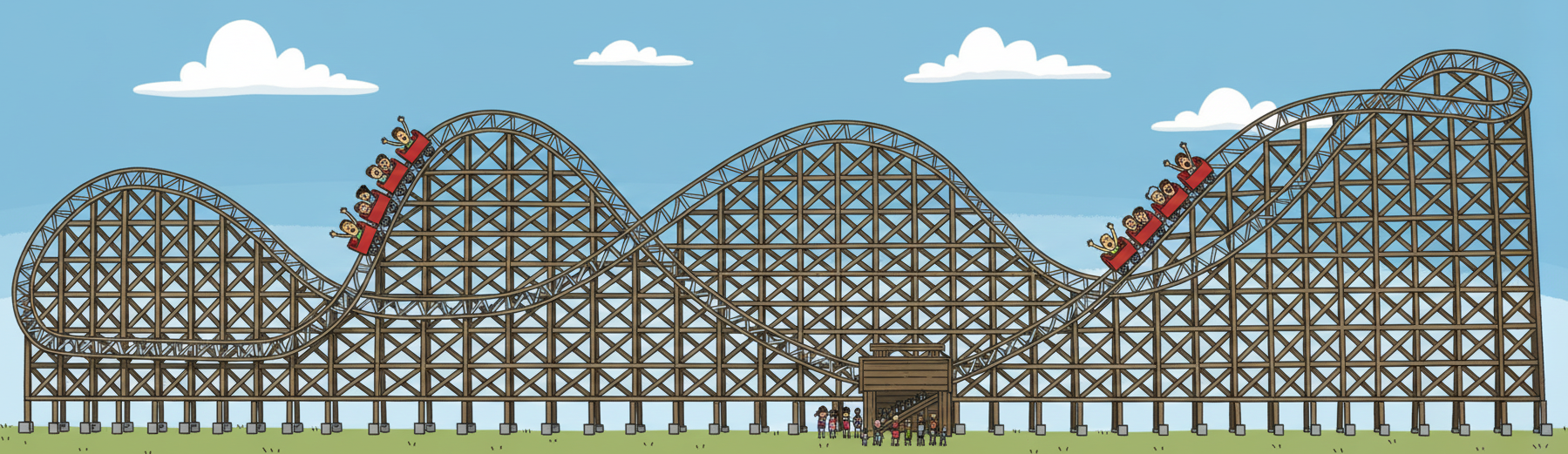
But a manager sees a team with idle time and says, “What is all of that empty track doing? I’m not getting my money’s worth! Make sure every inch of that track is fully utilized!”
So we load it up. Every inch of track is filled with cars. How fast is it moving now? Is anyone having fun? Is it productive? The line grows longer. Riders wait. They are not spending money elsewhere. Loading and unloading slows. Throughput drops. What used to be a one-minute thrill ride now takes hours.

The same thing happens to work in a department. The more work you allow to be in-process at a time, the more everything slows down. Your department will grind to a halt. If you believe that cost control and efficiency are as simple as doing as much as possible with the fewest people, you will end up saying things like, “It feels like we never really finish anything.” I can share with you what I saw happen:
- Deadlines slipped repeatedly
- Projects were “watermelons” — green on the outside, red on the inside
- Calendars were fully booked
- Meetings were scheduled weeks out
- Urgent work demanded special handling
- No one had time to help or learn
- Moving work between people was impossible
- One illness or resignation threatened collapse
- Home life suffered
We were maximizing utilization. We were maximizing delay.
Worse yet, attempts to fix it made things worse. Then something “urgent” appeared. We started it immediately to get ahead of it. That decision made it finish even later.
Expedites or special handling processes to speed things up only create flow debt, meaning accumulated delay on all other items in the system. When an ambulance plows through traffic, everyone else slows down to let it pass. The ambulance moves faster. Everything else moves slower.
The Fix is Limiting WIP
The fix is in the equation: Stop starting and start finishing. That requires changing how work enters and flows through the system.
- Develop a culture of pulling work instead of pushing it onto people.
- Everyone must be able to say “No.” Always saying “Yes” increases WIP.
- Determine which work is most valuable and protect the people doing the work from political pressure.
- Place limits on WIP. When flow slows, tighten the limits instead of relaxing them. Relaxing limits increases delay.
- Visualize the work. A Kanban system makes WIP visible and limits enforceable.
- Stop worrying about idle time. Full utilization increases queue cost and cycle time. You do not save money by pushing everyone to 100% utilization. You increase delay.
- Focus on availability. Knowledge workers need substantial slack. Availability creates space for innovation and collaboration. It speeds delivery. It allows learning. It produces better ideas. The amount of availability needed in your system may be 20% or higher depending on average variability.
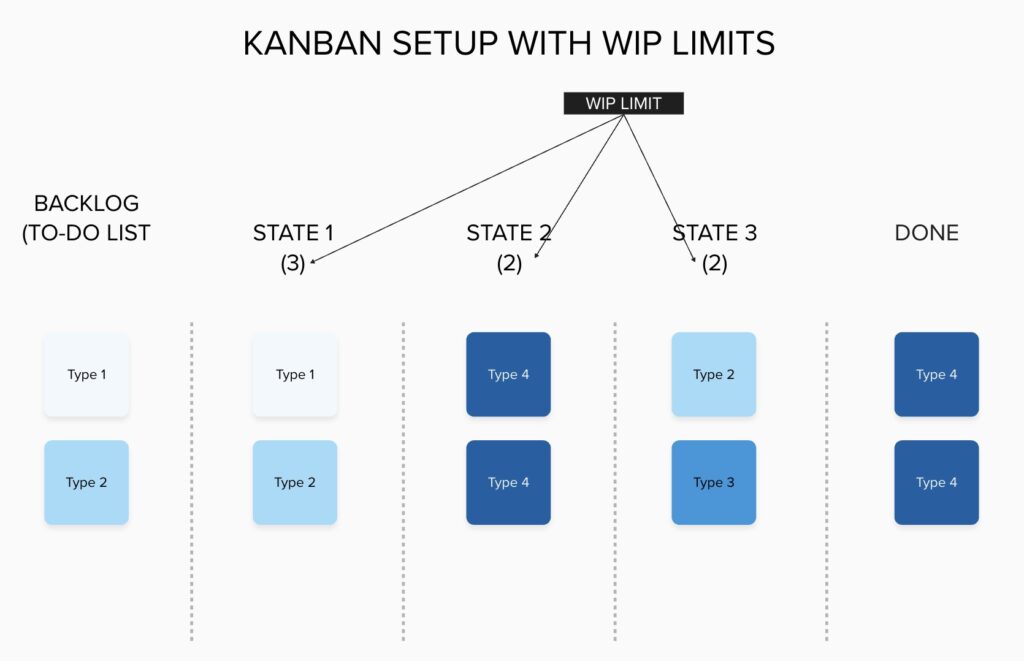
Many organizations adopt SAFe but overlook one of its most important mechanisms: limiting WIP at the program level. During PI Planning, only a fixed number of features are brought into the increment. That is a WIP limit. Exceed it and predictability declines. One of the great lessons SAFe reinforces is organizing around value. That means structuring decision-making around value, not just forming teams around products.
Not all work is equal. Much of it produces little or no value.
The Limit on WIP Limits
There are powerful forces that prevent organizations from limiting WIP. The solution to this is a culture that empowers employees. If decision-making is moved from high levels of management to self-managing teams which are aligned to particular requestors, those teams have the ability to limit the work that they are doing in rational conversations using a fixed capacity model where the most valuable things are chosen first.
WIP Limits are a keystone feature of any organization that speeds their delivery and improve quality.
Empowered teams allow people to limit WIP. Limiting WIP creates a pull system. Pull systems create transparency. Transparency is necessary for continuous improvement. Leaving out the limitations on WIP from any business process overhaul is a gigantic miss.
Reinertsen, Donald G. The Principles of Product Development Flow: Second Generation Lean Product Development. Celeritas Publishing, 2009
“Little’s law.” Wikipedia, The Free Encyclopedia, 22 Nov. 2023, https://en.wikipedia.org/wiki/Little%27s_law
“Visualize and Limit WIP, Reduce Batch Sizes, and Manage Queue Lengths.” Scaled Agile Framework, https://v5.scaledagileframework.com/visualize-and-limit-wip-reduce-batch-sizes-and-manage-queue-lengths/
Goldratt, Eliyahu M., and Jeff Cox. The Goal: A Process of Ongoing Improvement. North River Press, 2004
Vacanti, Daniel S. When Will It Be Done?: Lean-Agile Forecasting to Answer Your Customers’ Most Important Question. Daniel S. Vacanti, Incorporated, 2020. ISBN: 978-0986436376
Vacanti, Daniel S. Actionable Agile Metrics for Predictability: An Introduction. Daniel S. Vacanti, Incorporated, 2015. ISBN: 978-0986436338
Last updated 2026-02-21