
Work can be planned by asking how much can be completed by a certain date, or how long a known set of work will take. In this article, assume a known backlog of items that are valuable if delivered. The backlog should be ordered so that the most important items are completed first to reduce risk.
Controlling WIP Through Order
When work is ordered, it should exist in a single ranked list where each item has a unique position. If multiple items share the same rank, the system does not have a true order. A strict 1–N ordering ensures there is always a single next item to start.
With a well-ordered backlog, the team starts the most important item first and completes it before moving to lower-priority work. If multiple items can be worked at once, the team starts only the top few and waits to begin others until capacity is available.
Relative priority also guides decisions during execution. When work items compete or conflict, the higher-ranked item proceeds without requiring escalation. This reduces coordination overhead and preserves flow.
Stakeholders frequently describe several items as equally important. When that occurs, the backlog no longer provides clear sequencing guidance. If no item is more important than another, teams are likely to start several at once. This increases WIP and undermines the purpose of ordering.
A well-ordered backlog gives teams clear guardrails for making decisions on their own. Because priority is already defined, fewer clarification meetings are needed. This allows teams to act without constant escalation. It also helps them limit how many things they work on at once and choose the next item quickly when something becomes blocked.
Having a clear order is often more important than having a perfect order. Unique ranking allows teams to control WIP and sequence work consistently. While getting the order right matters, lacking clear order makes it difficult to manage flow at all.
Ordering Methods
Backlogs can be ordered in many ways. Some teams prioritize based on perceived business value. Others prioritize risk, stakeholder demand, or estimated cost of delay. Methods such as WSJF attempt to combine size and economic impact. Regardless of the method, the goal is to produce a clear 1–N ranking.
Any of these methods can produce a clear 1–N order. Some reflect stakeholder influence. Others rely on forecasts of value or effort. Regardless of the method, the important outcome is a unique ranking that allows work to be sequenced.
Not Ordering Methods
Some prioritization methods group items into categories rather than placing them in a strict order. MoSCoW is one such method, dividing work into Must have, Should have, Could have, and Won’t have. While this can help organize thinking, it does not create a clear 1–N ranking. Without that ranking, sequencing becomes difficult.
In many cases, several items are placed in the “Must have” category, leaving no clear order among them. When this happens, teams still need to decide which item to start first. Because the method does not require unique ranking, it often leaves sequencing incomplete.
When several items are labeled “Must have,” teams may feel compelled to work on many of them at once. This increases WIP and weakens priority control. If the goal is to create a clear 1–N order, grouping items into broad categories does not fully solve the sequencing problem.
Incentives and Order
Incentives affect how people prioritize work. Those measured by how many initiatives they sponsor often want many items treated as high priority. Those measured by overall business outcomes tend to prefer fewer active initiatives. These differences influence how much work is started at once.
Many leaders resist ranking two important items because placing one first means the other will wait. In organizations that reward starting many initiatives, deferral feels undesirable. Clear ordering requires accepting that not everything can begin at once.
One way to resolve this is to ask which item would be chosen if only one could be delivered. That selection defines the higher priority. When forced to select just one, order emerges.
WIP Impacts Order
Teams may spend significant time ordering a backlog, then start most or all of the items at once. When this happens, WIP increases and the order loses practical meaning. Higher utilization leads to longer cycle times and greater delivery risk for every item.
Once everything is in progress, the system will determine which items finish first, not the original order. Under high WIP conditions, smaller items are statistically more likely to finish first, while larger items remain in the system longer.
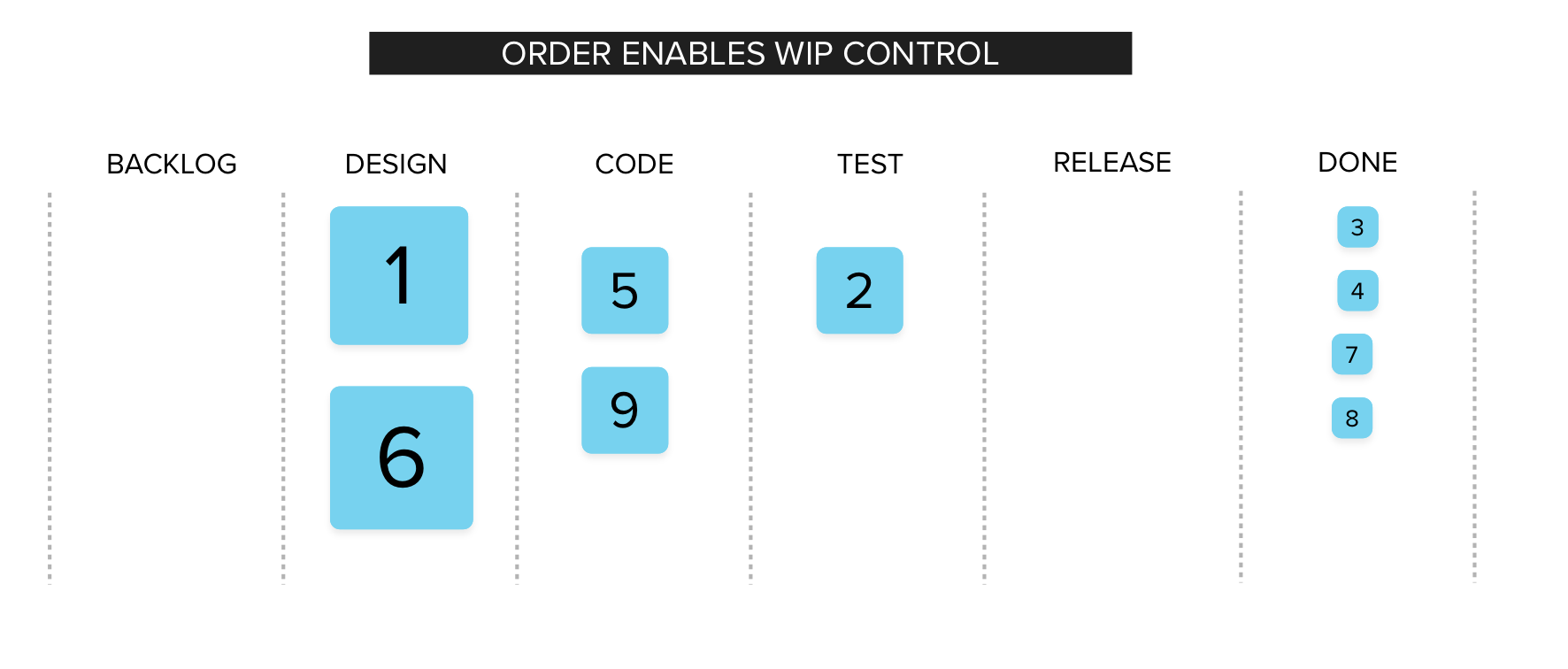
High WIP means that items are not completed in the order of the original agreements with stakeholders.
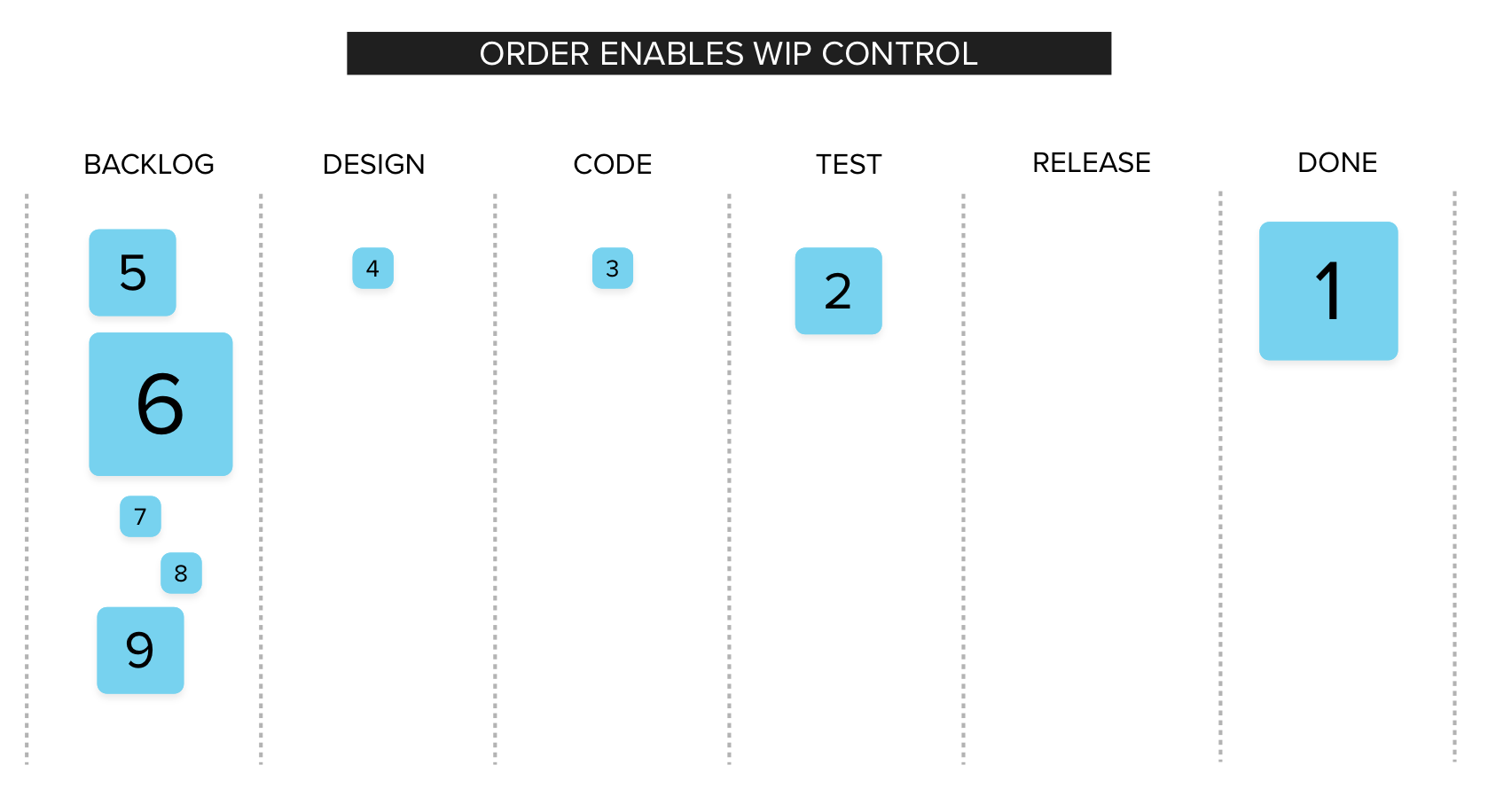
WIP control preserves priority during execution.
What is Important About Order
The most important things about order are these:
- Work should be placed in a strict 1–N order, with no two items occupying the same rank.
- If the list extends too far into the future, ordering it becomes time-consuming and expensive. Keeping the backlog short makes it far more manageable.
- Items waiting in the backlog are inventory in the value stream. A long backlog increases exposure to change and makes prioritization less reliable. Keeping the backlog short helps maintain clear order and reduces risk.
- Use the order to control WIP by starting only the highest-priority items and allowing lower-priority items to wait until capacity is available.
- Limit WIP by pulling only a small number of items at a time. If too many items are started, the order no longer influences completion.
- Avoid spending excessive time estimating large items that are far from execution. Estimates for distant work are more likely to change, and repeated re-planning increases cost.