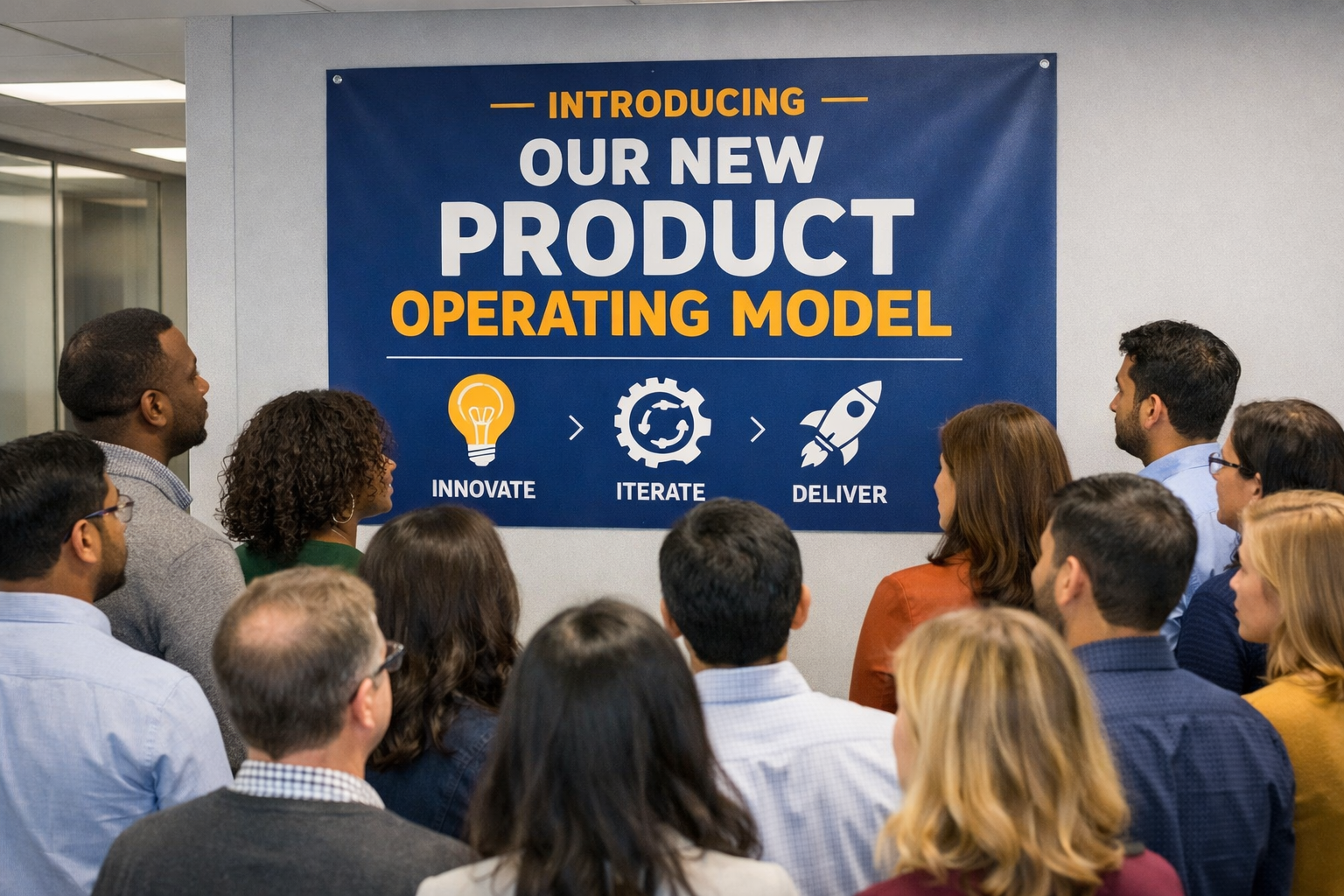
There are a lot of offerings out there for how to achieve rapid, small delivery with embedded feedback loops in an iterative, incremental way to manage uncertainty, reduce risk, and improve maneuverability. Lately there is a lot of focus on flow, and some are presenting what they call a “product operating model.”
I don’t care what we call it. The concepts underpinning any attempt to achieve desired business outcomes is the same. We know what will reduce risk, reduce defects, increase the pace of learning, lower cost to build, lower cost to own, and result in building the right thing.
– Small batch work
– Controlled work in process
– Managed variability
– Decentralization
– Job sequencing
– Cadence
– Transparency
– Short, small planning
You have no choice. To improve delivery, you have to manage these or you will increase costs and risks.
Most large companies still do software development in projects. They have a feature set they want to release, and they bundle those features together under an idea. The project is named, it is proposed, discussed, approved, funded, and then sent to someone to build and release it.
The problem is not that it doesn’t work. It does work. Software is built and released.
The main problem with project-based approaches in IT is it is porting a construction industry approach from its context of low-uncertainty to software development which is frequently high uncertainty. Far horizon planning and large batch work will always slow the cadence of learning and increase risk. Interruptions increase as cycle time increases. As work-in-process increases, priorities become meaningless and delivery slows. Putting features together into a bundle and working them all together causes batching which leads to most of the delivery problems organizations experience.
We wrongly believe that uncertainty can be planned away, which leads to the waste of planning many features in large batches and attempting to deliver them all at once—an approach that has likely cost the industry trillions through unwanted ideas, war rooms formed to support complex defect investigations, and expensive change control processes that ultimately result in rework.
This result isn’t surprising for businesses that believed that magical ceremonies and sprints would control costs and improve sales.