
Much progress has been made in the last 20 years in how we plan software development projects. We have moved from the age of the large batch release, planned months or even years in advance. Few organizations are still moving projects through the lifecycle together from phase to phase grouped by release. This utilization scheme was intended to keep everyone busy. While it was effective at producing busyness, the outcome was only the illusion of savings. Delivery times were long, and defects were high.
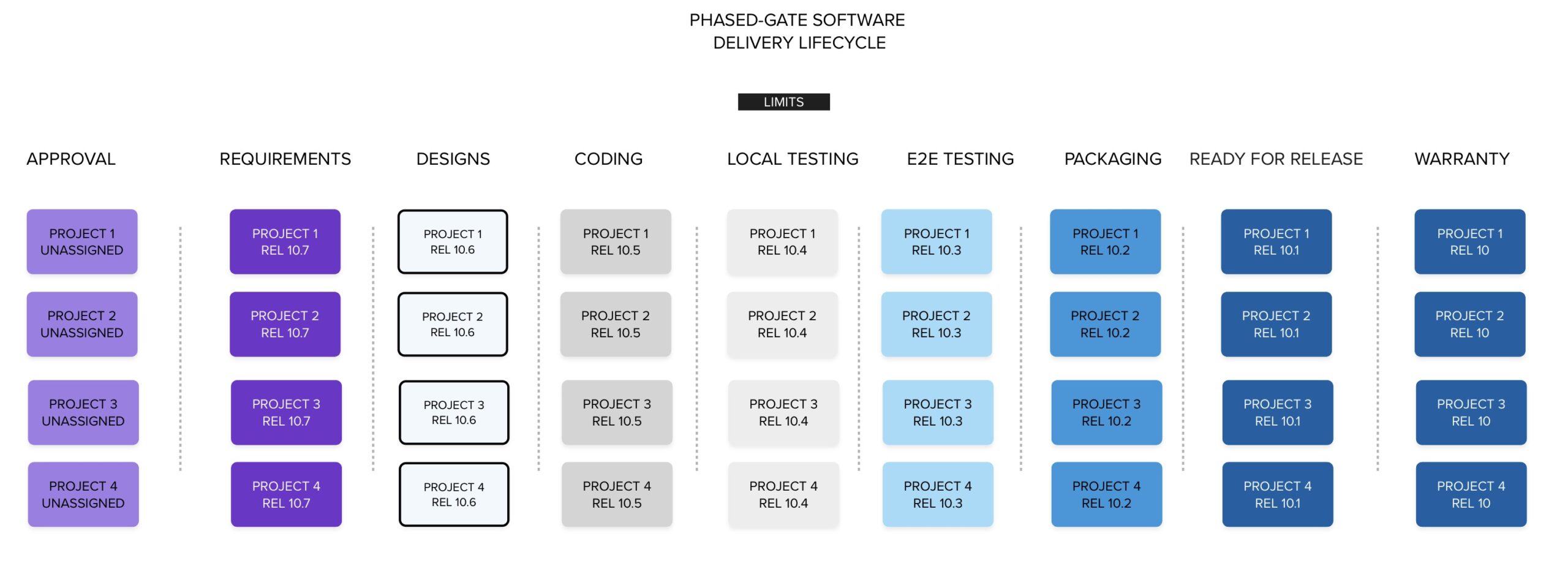
Most businesses are currently operating in what can be described as the project model. They no longer group projects into large release batches and move them through a phased-gate process. Projects now flow through the system independently, although they are sometimes consolidated at completion for coordinated release.
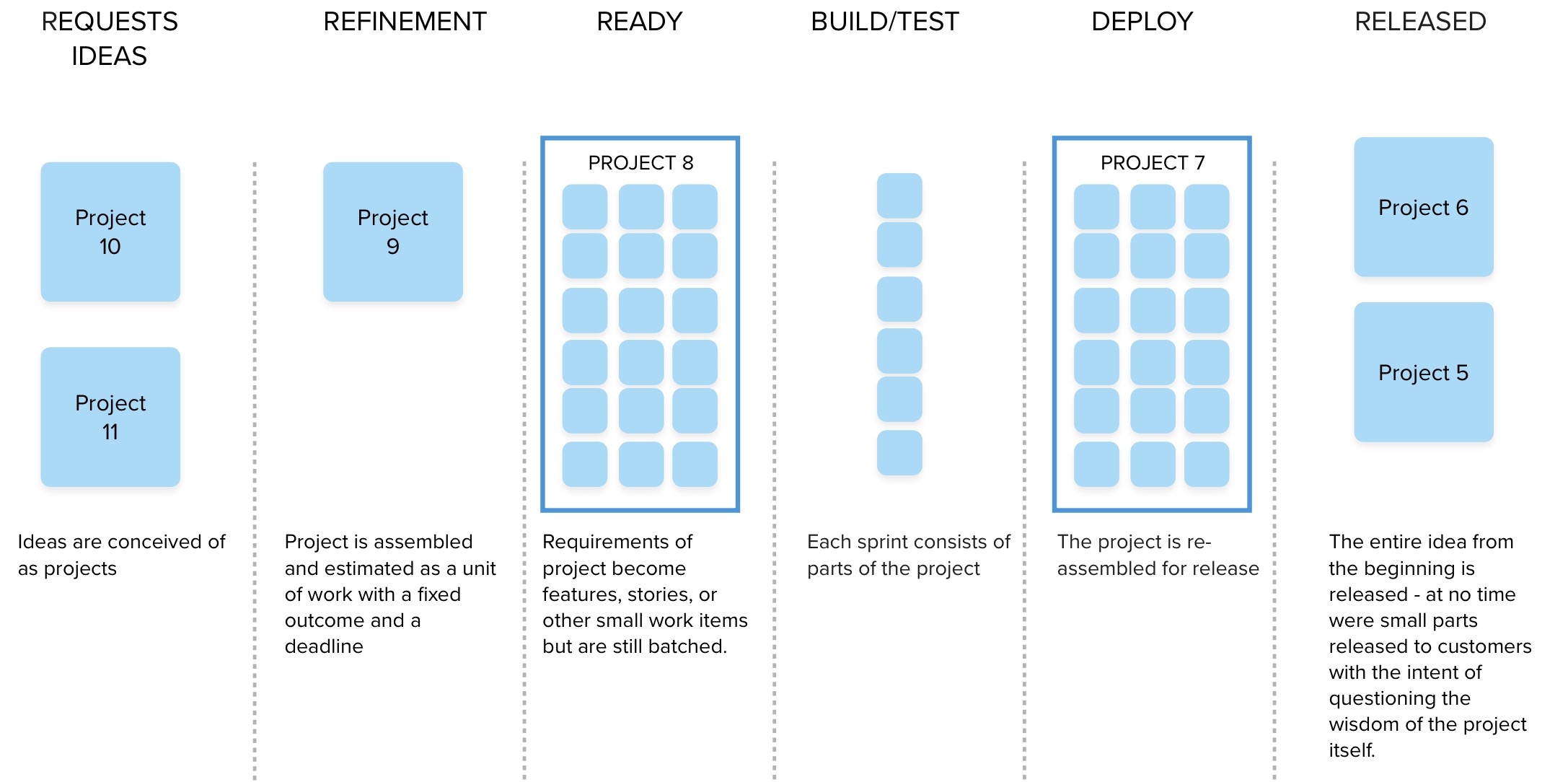
It represents progress, but it does not achieve the full objective. The objective is to release small increments frequently in order to obtain rapid feedback. This enables better product decisions, reduces risk, accelerates value realization, lowers build and ownership costs, and improves quality. This cannot be achieved while comprehensive, detailed planning extends far into the future.
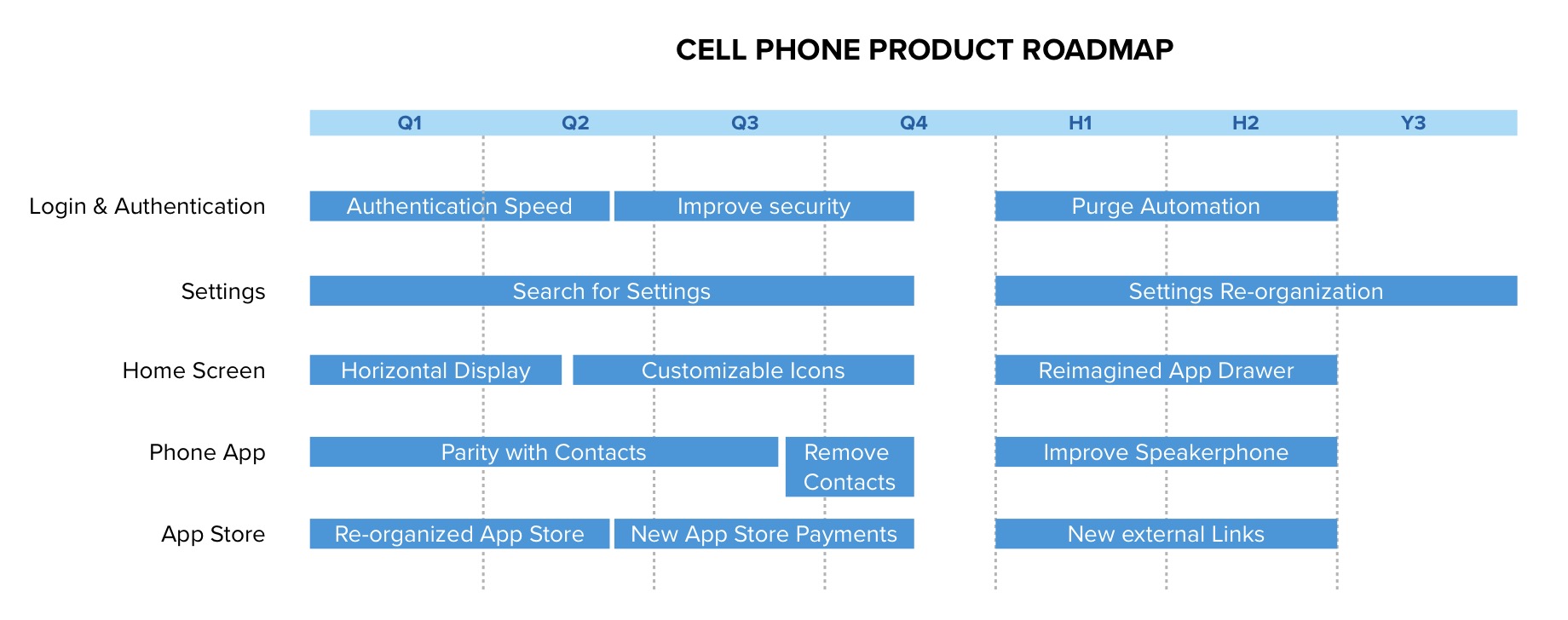
Far horizon planning should not be confused with roadmapping. A roadmap is a high-level visual representation of anticipated changes. It is simple, inexpensive to produce, created quickly, and treated as a living document that evolves as new information emerges. Roadmapping, when practiced this way, is not the issue. The issue arises when roadmaps become detailed, comprehensive plans.
Why Too Much Planning is the Problem
Far-horizon planning occurs when detailed scope, assigned resources, and committed delivery dates are established far in advance across a broad body of work, with the expectation that the plan will remain stable over time.
Such plans assume that uncertainty can be sufficiently anticipated and controlled through detailed upfront specification.
Many large organizations operate under the assumption that risk is reduced through comprehensive planning. In practice, the opposite tends to occur. As plans become more comprehensive, the perception of reduced risk increases. In reality, expanded scope and longer horizons introduce additional variability, complexity, and waste.
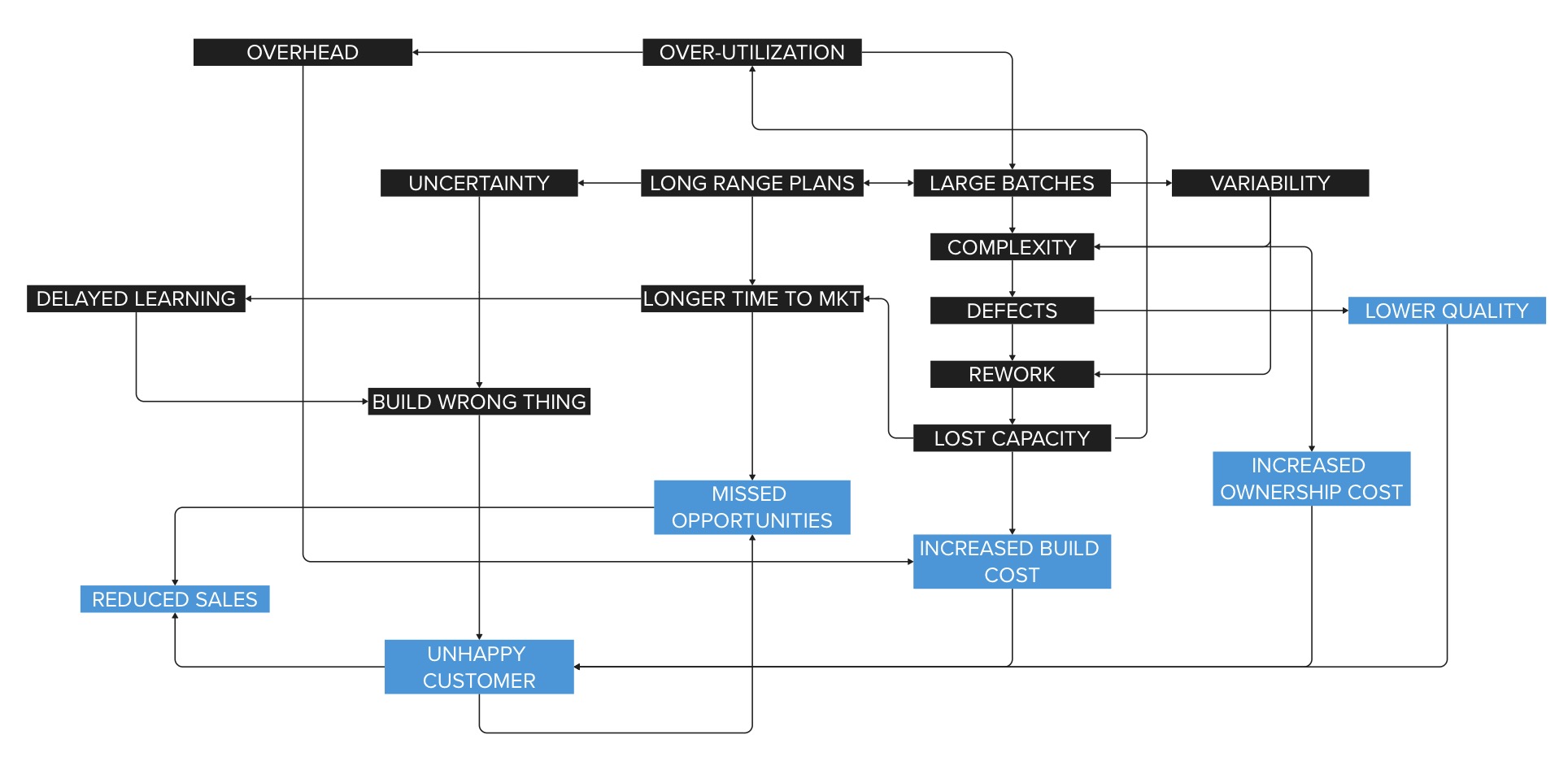
The Organizational Consequences of Long-Range Planning
- Increased cost. As planning extends further into the future, plans grow in size, documentation increases, complexity expands, and more people and activities must be coordinated. A short-horizon plan is comparatively simple, inexpensive, and quick to produce.
- Increased loss and waste. Large plans created at the outset are often revised or abandoned as new information emerges. The more detail invested upfront, the greater the cost of revising or replacing the plan. Organizations committed to comprehensive plans often feel compelled to revise the entire long-range plan rather than adjust only the near term, further increasing cost and waste.
- Decreased value delivery. Large plans delay the realization of value, reducing opportunities for revenue and return on investment.
- Increased cycle times. When planning extends far into the future, time to market increases. If an idea is implemented immediately, time to market is short. If delivery is scheduled six months in advance, time to market is already six months before work begins. Planning is most effective when it focuses on a near-term horizon where uncertainty is manageable, typically a few weeks to a month.
- Increased variability. Large upfront plans increase the likelihood of unexpected events occurring late in execution, when changes are more expensive to address. As scope and planning horizon expand, exposure to variability increases.
- Over-utilization. Larger plans increase the likelihood that many people work on multiple initiatives simultaneously. This creates pressure to increase work in process, reducing availability between individuals and teams. As availability declines, queues form and response times increase across the organization. Additional coordination effort is then required to overcome the perception that all capacity is fully consumed. As utilization approaches capacity, collaboration declines and the time required to complete cross-functional work increases.
- Increased risk. Long-range plans typically encompass broader scope and aggregate more work into a single delivery. Concentrating scope into a single release increases the magnitude of potential failure. Defects and issues are more difficult to isolate and correct. Release complexity increases significantly.
- Increased coordination overhead. As plans increase in scope and complexity, additional coordination roles are typically introduced to align activities across teams. These roles increase operating cost and consume organizational capacity by requiring time and participation from others.
- Decreased predictability. As plans become larger and more comprehensive, their accuracy declines. The further a plan extends into the future, the more it diverges from current conditions, reducing the reliability of time, cost, and scope estimates.
- Lost urgency. As planning horizons extend, perceived urgency across the organization declines. Work scheduled far into the future reduces the immediate pressure to deliver. Extended timelines normalize slower execution. Delayed feedback and extended timelines reduce urgency across delivery teams, leadership, and stakeholders.
- Disempowerment. As plans become larger and more detailed, team autonomy declines. Smaller increments allow teams to make near-term decisions collaboratively. Large, complex plans require coordination across multiple teams, often leading to additional governance structures intended to provide leadership with visibility and control. Teams are empowered by short-horizon planning. As control is centralized to increase visibility, responsiveness at the team level declines.
If long-range planning produces these systemic effects, what replaces it?
Short Horizon Planning
Short-horizon planning applies detailed planning only to the near term, typically one to four weeks. A sprint backlog is an example of a short-horizon plan. One of the intended purposes of sprints was to confine detailed planning to a short window in order to reduce the systemic consequences of long-range planning.
Beyond that near-term window, planning shifts to a roadmap. A roadmap provides high-level direction and sequencing without detailed scope or fixed delivery commitments.
At the end of each sprint, results are reviewed and the next short-horizon plan is created. Those results may confirm the roadmap or require it to be adjusted. Detailed planning is deferred intentionally. By waiting for evidence before committing to the next increment, risk is reduced and adaptability increases.
Short-horizon planning does not eliminate long-term thinking. It changes the resolution of planning at different distances.
Implementing Short-Horizon Planning
Over-planning is a systemic problem in product development. Under-planning is rarely the primary issue, as long-range plans seldom prove accurate. Instead, working in short, incremental cycles of delivery and learning is more effective. This approach increases team autonomy, improves predictability, reduces variability, and shortens time to market.
Examine company processes, policies, and systems to ensure they do not obstruct small, incremental delivery, and revise them where necessary.
- Embrace empiricism and acknowledge that customer response and future conditions cannot be known in advance. Eliminate requirements that bundle requests into large projects in order to reduce administrative overhead. This practice creates large batches of work and introduces the same systemic issues described earlier. Limit planning scope to increments no larger than a single feature implementation. Progress further by framing work as experiments designed to test assumptions and generate evidence.
- Reconsider policies that require all future work to be fully specified in advance for budgeting purposes. Adopt budgeting approaches that fund products or value streams rather than fixed-scope projects, such as SAFe’s Lean Portfolio Management.
- Avoid practices that require a large idea to be decomposed into all possible detailed components upfront. This approach resembles a work breakdown structure rather than a backlog focused on the most valuable next increment. Identifying a small starting point does not require complete knowledge of all future work, nor comprehensive specification of every possible task.
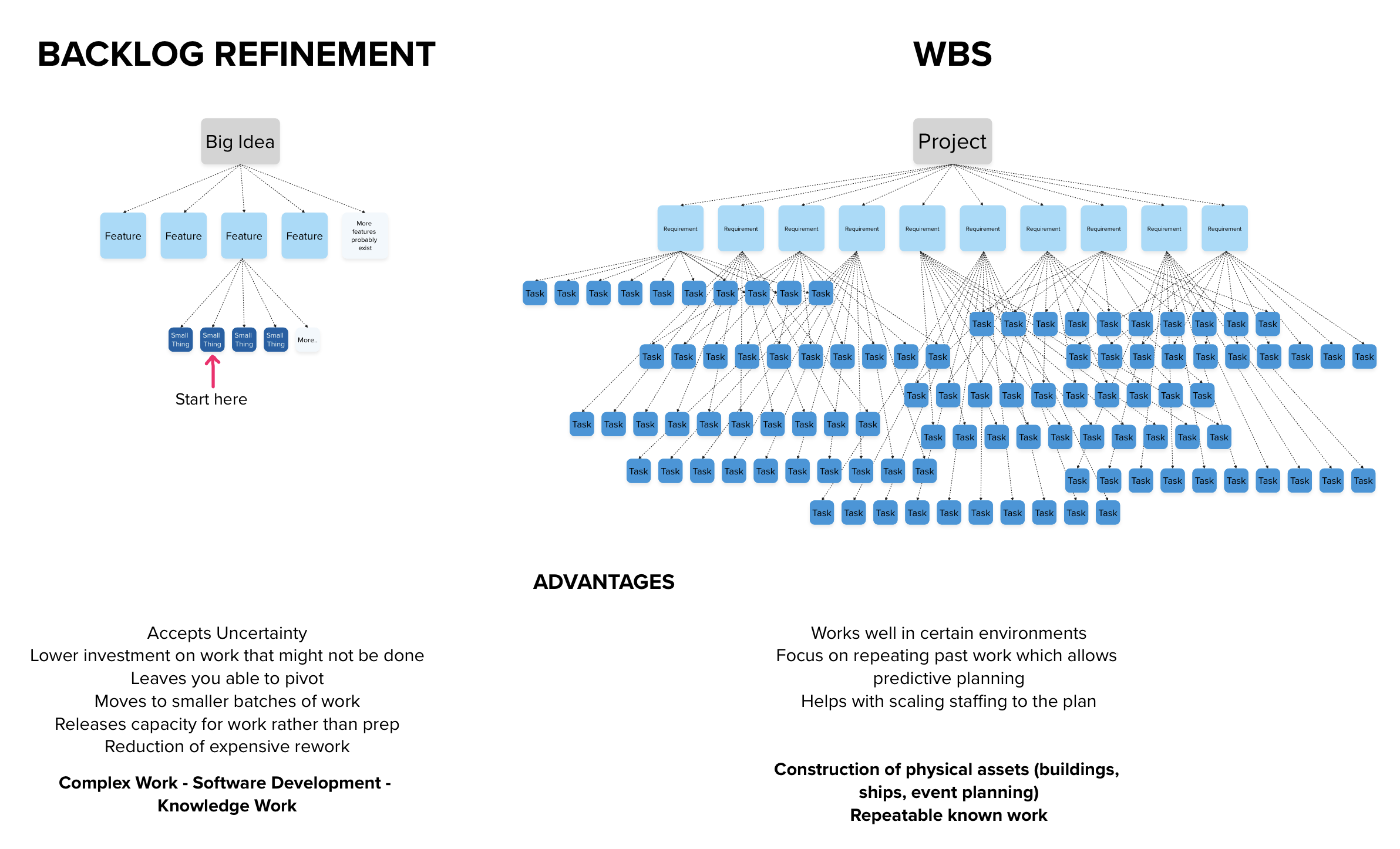
- Measure cycle time. Know how long it takes for an idea to reach production, and make the reduction of that time a primary objective. The number of days from idea to release reflects the organization’s level of agility. If it exceeds a few months, significant opportunity exists to improve responsiveness.
- Move away from scheduled release cycles. Invest in continuous delivery automation and enable on-demand, incremental releases.
- Measure business outcomes. De-emphasize project counts, budgets, and schedule adherence as primary success measures. Prioritize measures of customer response and business impact, such as sales, revenue, adoption, or engagement. Ensure that the original business rationale for the work is explicitly measured and that results are visible across the organization.
- Embrace transparency. If experimentation and early learning are punished, the organization will not sustain these practices. Encourage early learning and treat negative results as information rather than failure. Experiments generate knowledge that improves decision quality.
Identify a small, manageable starting point and begin delivering. Maneuverability begins at that scale.
Last updated 2026-02-22