
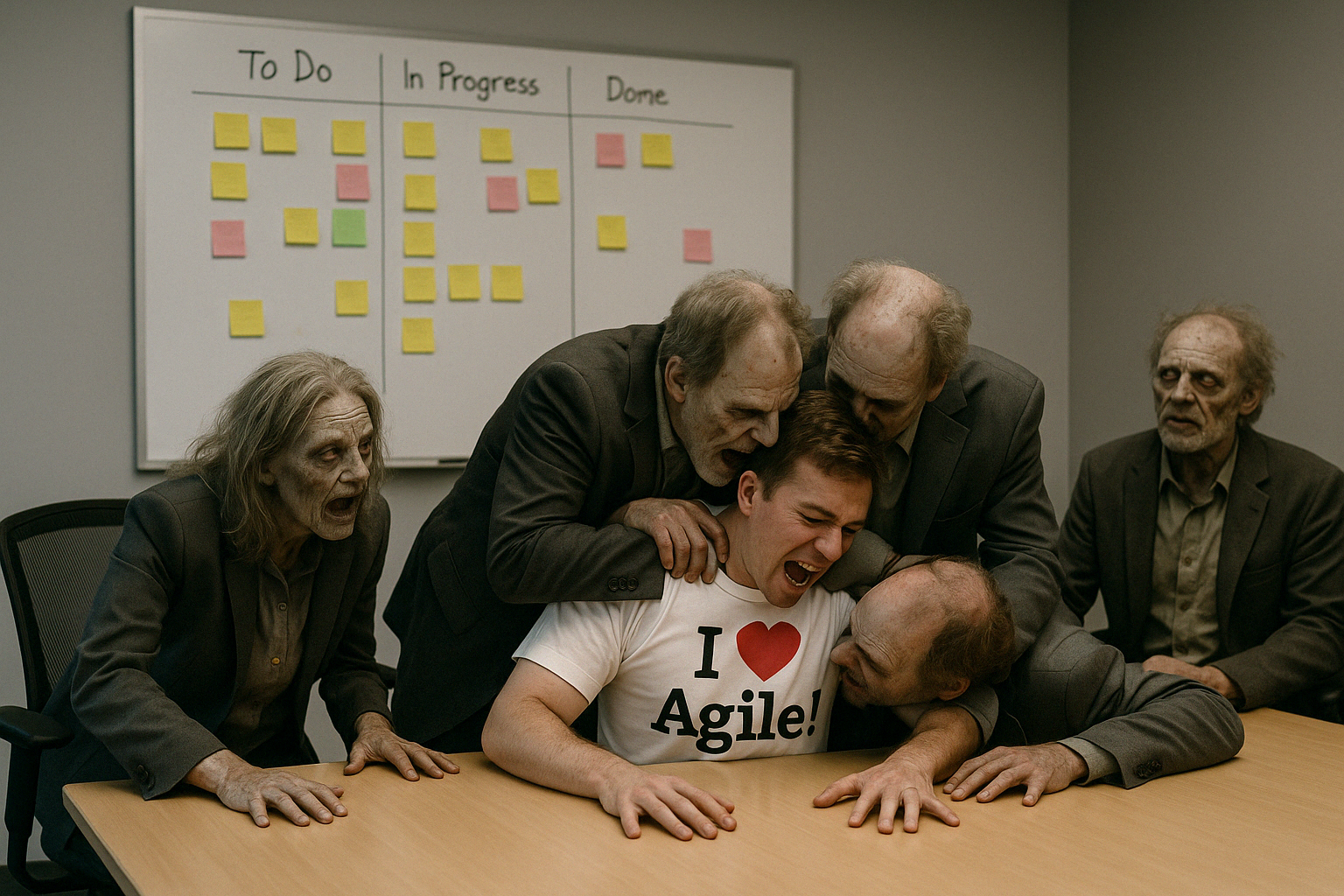
Most corporate agile teams are zombie teams. They say they are “doing agile” because they hold a 15-minute daily meeting, maintain a backlog, refer to their requirements as “user stories,” and use a visual tool like Jira or Azure DevOps. But they are not agile. Like zombies, they groan and shuffle about as though they are alive. But… they are the walking dead.
There are many names for this phenomenon:
- Corporate Scrum
- Zombie Scrum
- Zombie Agile
- Corporate Agile
- Agile Theater
- Scrum Theater
- W-Agile
- Fake Scrum
- Dark Scrum
- Dark Agile
- Scrumfall
- Waterscrum
All of these terms point to the same thing: a team or organization that calls what it does “agile,” but upon closer inspection, shows little or no sign of agility.
Detecting zombie processes is not difficult. Start by answering these questions:
How many days does it take from the moment your organization has a new idea to the moment a customer uses it and you begin collecting feedback?
🧟♂️ A zombie team has no objective data that tells them they are doing well. They are probably measuring velocity and just repeating the measurement without making any decisions based on the data they are collecting. Reports are created and inspected, but no adaptations are made.
🚀 If the purpose of an agile team is to respond to or leverage change for competitive advantage, then truly agile teams will know this number, and it will be low. As in single digits.
What have you changed about the process at the team or organizational level since the previous sprint?
🚀 An agile team is an empowered group that decides how it works. An agile team is given a problem to solve and determines how to solve it.
🧟♂️ Zombie teams are handed solutions to deliver. If the process is dictated from above with required forms, reports, steps, and restrictions, and the team has little voice in any of it, then what you have is a zombie team.
Does your team have a solid setup that works pretty well?
🧟♂️ Zombie teams have a “setup.” They do not want to change. They want to do the same thing repeatedly one iteration after another.
🚀 Agile teams are constantly experimenting with how they work to better deliver value. Everything is always up for change. Agile teams will drop a tool that no longer helps them.
You say your team does good work and things are going well. How do you know?
🧟♂️ Zombie teams assume things are going fine because no one complains.
🚀 Agile teams seek out objective measures. They use metrics like cycle time, throughput, usage data, customer satisfaction, and business results to learn whether changes are helping or hurting. They understand that without change, there is no improvement.
How do team members behave?
🧟♂️ Zombie team members want to be told what to do. They want the PO to sign off and for contract-based process steps to be followed. This often manifests as a strict Definition of Ready designed to help the developers defend themselves against blame instead of collaborative conversations during backlog refinement.
🚀 Agile team members are highly vocal during events. Work is collaborative and everyone participates. Team members discuss problems and potential approaches to solving them. When told what to do, an agile team will instinctively complain and push back.
Have you created a Zombie Apocalypse?
I have observed several common causes:
- Underestimating how complex lean and agile concepts, practices, and adoption can be
- Believing that agile working techniques magically enable teams to do more with less – without cultural change
- Attempting to adopt agile while preserving the status quo
- A large, traditional organization with a small group experimenting with agility in isolation
- An IT department trying to adopt agility without support from other key functions such as Finance, HR, or Marketing
Real agile adoption begins when leaders recognize that the status quo cannot be preserved if improved results are expected. Improvement requires change. Teams that cannot or will not change are zombies, wandering the halls, pretending they are alive.
Unlike fictional zombies, these teams are not lost to us. When properly empowered and taught the true scope of continuous improvement, teams zombie teams wake up.
The Zombie Scrum Survival Guide was the inspiration for this article. While that book focuses on Scrum, there are Zombie teams everywhere doing all kinds of jobs. There are even zombie employees who are doing jobs that never improve and over which they have no control. Stop the zombie apocalypse! Empower teams and individuals, and stop believing in a status quo that is sufficient and unchanging.